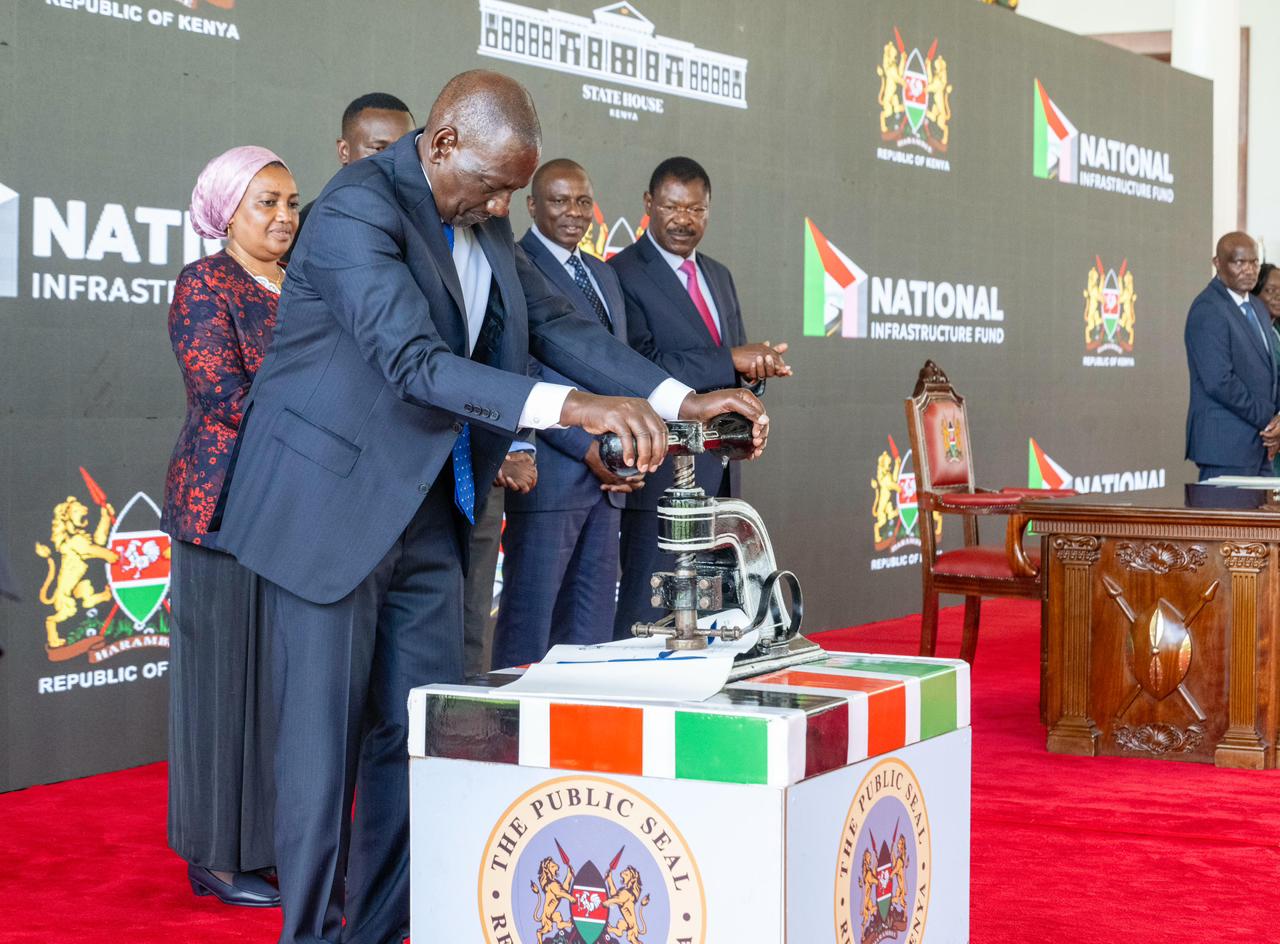
 President William Ruto during the Presidential Assent to the National Infrastructure Fund Bill, State House on March 9, 2026. Photo Courtesy


By Andrew Mbuva.
President William Ruto on Monday signed the National Infrastructure Fund Bill, 2026 into law, unveiling a new financing model aimed at mobilising trillions of shillings for the country’s infrastructure development while reducing reliance on public debt.
Speaking during the signing ceremony at State House, Nairobi, the President described the move as a historic turning point that will reshape how Kenya finances critical national projects such as roads, railways, ports, power, housing and irrigation.
Ruto said the establishment of the fund signals a shift from the traditional debt-driven development approach to a more sustainable, investment-led framework capable of unlocking large-scale infrastructure financing.
“For too long, Kenya has been a nation of great ambition without the financial resources to match it,” the President said, noting that the new law will enable the country to mobilise capital needed to accelerate development.
Under the new framework, the government plans to tap domestic savings, particularly pension funds and institutional investors, to finance long-term infrastructure projects.
According to the President, pension assets in Kenya grew by Sh700 billion last year, bringing the total value of pension savings to Sh2.81 trillion, resources he said could be channelled into national development.
The fund will also receive an initial boost from proceeds raised through the Kenya Pipeline Company Initial Public Offering, which generated Sh106 billion. The government intends to leverage this capital up to twelve times to unlock about Sh1.2 trillion for infrastructure investment.
Over the next decade, the administration aims to mobilise nearly Sh5 trillion through the new financing model.
Ruto announced that the expansion of Jomo Kenyatta International Airport (JKIA) will be the first major project financed through the National Infrastructure Fund.
The project will be structured through a mix of equity from the fund and participation from domestic institutional investors.
The President argued that heavy dependence on foreign borrowing has exposed many African countries to risks such as high interest costs and currency fluctuations.
He noted that financing infrastructure using foreign loans often leads to currency mismatches, where projects generate revenue in local currency while loans must be repaid in foreign currencies.
By mobilising domestic capital, the government hopes to reduce these risks while aligning long-term national projects with long-term local savings.
The law establishes a Governing Council responsible for strategic oversight of the fund, while Parliament will maintain supervision over investment policy to ensure transparency and accountability.
The President said the fund will operate under strong corporate governance standards and will work closely with development finance institutions including the World Bank and the International Finance Corporation.
Ruto said the initiative marks the beginning of a new phase in Kenya’s development agenda, one that focuses on large-scale investments in infrastructure to support agriculture, industrialisation, and economic growth.
“This represents more than the creation of a fund,” he said. “It is a new chapter in how Kenya finances its future.”
The government believes the strategy will help accelerate the country’s transformation by financing modern transport networks, energy projects, irrigation systems, and other key economic infrastructure.