
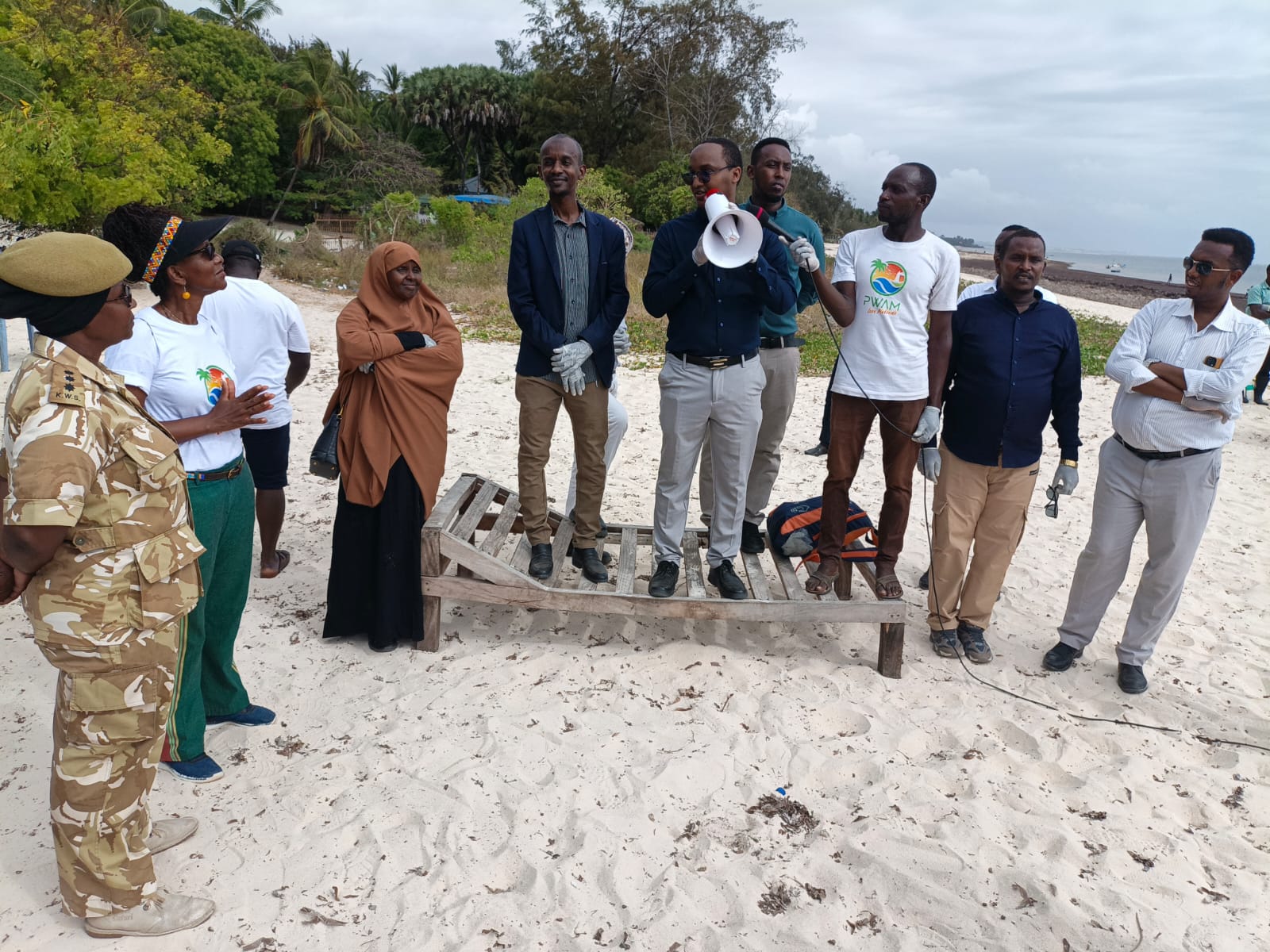
 A delegation from Berbera municipality in Somaliland led by the Director of Planning and Development Department Abdisamad Bihi and officials from the United Nations Human Settlement Program (UN-HABITAT) Waste Wise Cities led by National Programme Officer Jeremiah Ougo join members of the Progressive Welfare Association of Malindi (PWAM) that is chaired by Kate Mwikali during the monthly beach cleanup exercise at Olympia beach in Malindi town, Kilifi County on Thursday, January 22, 2026. Photo by Ben Okweingoti


By Ben Okweingoti.
The United Nations Human Settlements Programme (UN-Habitat) has committed to support Malindi town in Kilifi County to scale up sustainability programmes on waste management and recycling, strengthening efforts to promote a circular economy in the coastal tourism hub.
Malindi, a leading resort town on Kenya’s coast, has earned regional recognition for its coordinated approach to environmental conservation, anchored on monthly beach and town clean-up exercises organised by the Progress Welfare Association of Malindi (PWAM). The initiative brings together a wide range of stakeholders, including community-based organisations, conservation groups, the National Police Service (NPS), Kenya Wildlife Service (KWS), hoteliers, schools and beach operators.
The town’s progress has now attracted international attention, with a delegation from Berbera Municipality in Somaliland visiting Malindi to benchmark on solid waste management and recycling best practices.
The delegation, led by Abdisamad Ahmed Bihi, Director of the Planning and Development Department at the Berbera Municipality Authority and Head of the Focal Point for the Berbera Urban Development Project, took part in the monthly clean-up exercise at Casuarina Beach.
Speaking during the exercise, Bihi said the delegation was keen to learn how Malindi manages solid waste through a multi-stakeholder approach with the aim of replicating similar initiatives back home.
“We are impressed by how all stakeholders — from local communities to government officials — work together to manage waste. This collective responsibility is key, and it is something we would like to adopt in Berbera,” he said.
He noted that the visit was part of a Learning Exchange Programme between municipalities in East Africa and the Horn of Africa, facilitated by UN-Habitat.
UN-Habitat’s National Programme Officer at the Regional Office for Africa, Jeremiah Ougo, said the agency is working closely with municipalities across the region to promote sustainable urban development, enabling cities such as Berbera to benchmark in Malindi.
Ougo revealed that UN-Habitat had recently concluded the Go Blue programme, a four-year initiative worth €7 million that targeted all six coastal counties in Kenya, with Kilifi County among the beneficiaries.
“Although the programme has closed, there are already strong reasons for us to continue engaging with Malindi. It is encouraging to see recycling and circular economy initiatives taking root here,” he said.
He added that UN-Habitat has already established a Material Recovery Facility in Mwatate, Taita Taveta County, and disclosed that there was a possibility of setting up a similar facility in Malindi.
Local conservationist Rita Valentini showcased high-end products made from recycled waste materials in Malindi, some of which are exported to premium markets in Europe at high value, demonstrating the economic potential of the circular economy.
PWAM Chairperson Kate Mwikali said the association was honoured to host the Berbera delegation and UN-Habitat, noting that the visit validated Malindi’s grassroots efforts in sustainable waste management.
“We are proud of what we have achieved through collaboration. Beyond clean-ups, we are also using conservation activities to create awareness and livelihoods,” she said.
Mwikali further announced that in November this year, Malindi will host its first Wetlands Marathon, running from the Sabaki River mouth to Malindi Marine Park, aimed at promoting wetland and marine conservation.
Kilifi County KWS Warden in charge of Malindi Marine Park, Ntindi Kassim, said inter-agency collaboration had significantly improved beach cleanliness and reduced threats to endangered marine species.
“The impact of these partnerships is visible. Cleaner beaches mean a safer environment for marine life and a better experience for visitors,” he said.
Malindi Tourist Police Unit (TPU) Officer Commanding, Vicky Odhiambo, said the police regularly participate in environmental activities to sensitize the community on conservation and help maintain a clean and safe town.
Stakeholders represented in the initiative included Malindi Municipality, the Sub-County Environment Office, Malindi Water and Sewerage Company, Public Health Department, National Police Service, Kenya Wildlife Service, hoteliers, beach operators and boat operators, among others.
With UN-Habitat’s backing and growing regional interest, Malindi is increasingly positioning itself as a model coastal town for sustainable waste management and circular economy practices in the region.