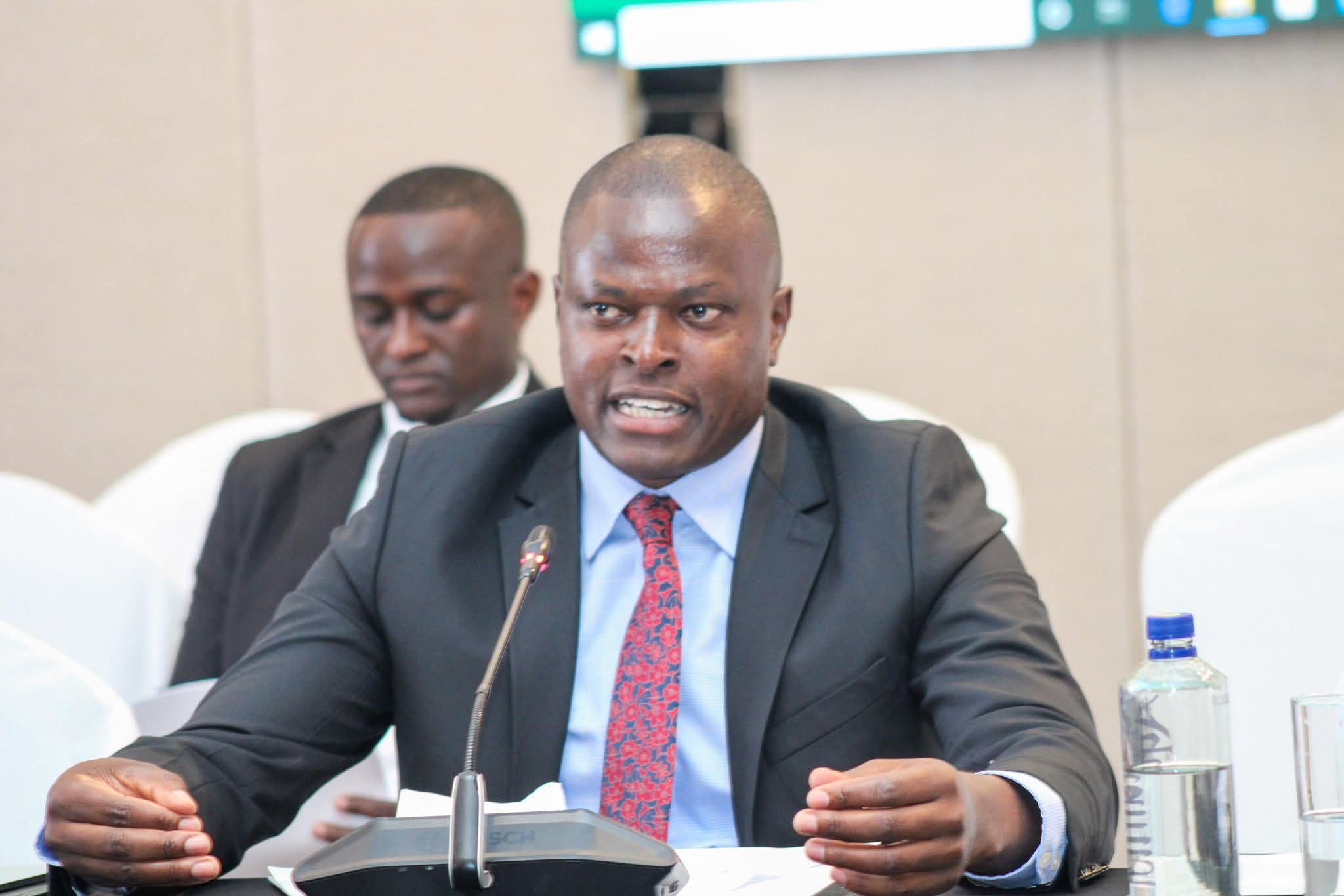
 Kiharu MP Hon. Ndindi Nyoro appearing before the National Assembly’s Joint Committee on Finance and National Planning, and Public Debt and Privatisation on January 20, 2026. Photo by PBU


Kiharu MP Hon. Ndindi Nyoro has called for thorough public participation and debate over the proposed sale of a 15 per cent government stake in Safaricom PLC to Vodacom, warning that the transaction risks undervaluing one of Kenya’s most prized public assets.
Appearing before the National Assembly’s Joint Committee on Finance and National Planning, and Public Debt and Privatisation, Nyoro said the proposed sale is the largest of its kind in both size and value since independence and must therefore be subjected to rigorous public scrutiny.
The lawmaker argued that an open and robust national debate would help secure the highest possible value for taxpayers. He urged the National Treasury and the government at large to approach the transaction with the mindset of a seller seeking the best deal, rather than defending what he termed an inferior proposal.
“The National Treasury and indeed the entire government must have the demeanor of a seller, get as many views from Kenyans, and adopt them instead of justifying an inferior transaction,” Nyoro told the committee.
Nyoro also raised concerns over the negotiation process, questioning whether individuals who are not public officers or officially contracted by the government participated in the deal. He called on the government to clearly disclose all parties involved in the negotiations.
“It is apparent that some of the people who participated in the negotiations, ostensibly representing the people of Kenya, are not public officers or servants and are not officially contracted to act on behalf of the government,” he claimed.
The second-term MP further criticised the valuation underpinning the proposed sale, terming it grossly undervalued and unreflective of Safaricom’s true worth. He noted that in 2021, even before the company’s expansion into Ethiopia, Safaricom shares were trading at about KES 45 on the Nairobi Securities Exchange, translating to a valuation exceeding KES 1.8 trillion.
According to Nyoro, the company’s valuation should now be higher, especially considering that its Ethiopian investment is close to breaking even operationally. He cautioned against relying solely on the current NSE share price, describing it as an unreliable benchmark.
To illustrate his point, Nyoro cited Kenya Power, which he said has assets valued at over KES 400 billion but a market capitalisation of about KES 27 billion, questioning whether it would be prudent to dispose of public assets based on such distorted market valuations.
As an alternative to the proposed sale, Nyoro suggested that the government consider a demerger to unlock greater value. He proposed splitting Safaricom into three distinct entities, arguing that the combined value of the separate units would be significantly higher than the current valuation of the company as a whole.
“The sum total of the three entities would be valued much, much higher than the whole. Why the hurry to sell our most prized assets at a discount?” he posed.
The MP also called for greater transparency regarding the intended use of proceeds from the sale, urging the government to clearly outline which development projects would be financed using the funds.
Nyoro’s remarks add to growing debate over the proposed Safaricom stake sale, with calls mounting for accountability, transparency and value-for-money in the disposal of strategic public assets.
By PBU.