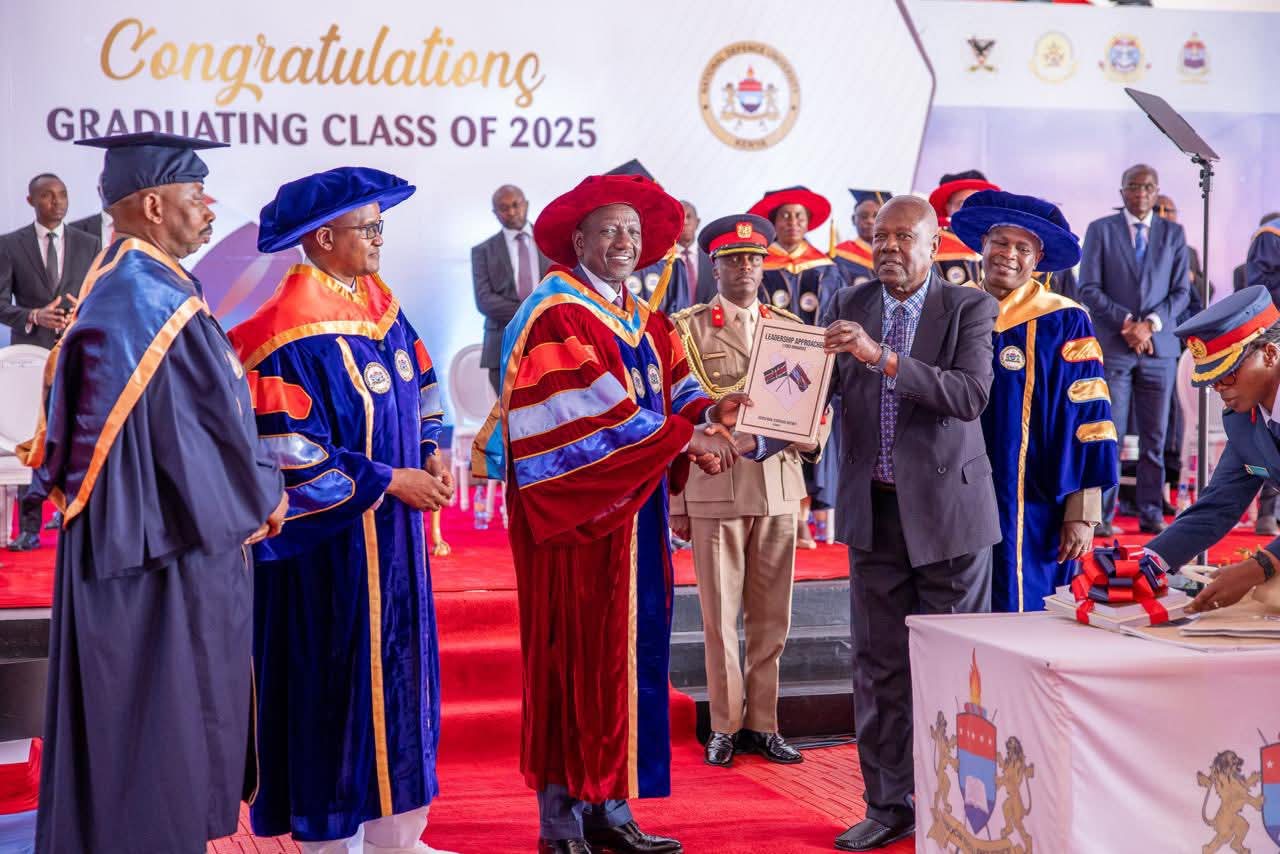
 President William Ruto Awarding graduates at the 3rd Graduation Ceremony of the National Defence University–Kenya (NDU–K) in Lanet, Nakuru County on November 21, 2025. Photo by PPS


By Ryan Mumo
President William Ruto has declared research-driven security innovation and accelerated human capital development as the backbone of Kenya’s next phase of national advancement, as he presided over the 3rd Graduation Ceremony of the National Defence University–Kenya (NDU–K) in Lanet, Nakuru County on Friday.
Addressing graduates, military leadership, faculty and invited dignitaries, the Head of State said the country must now adapt to a rapidly changing global security environment characterised by blurred threats, fast-evolving technology, and the disruptive rise of artificial intelligence.
He warned that Kenya’s defence and security architecture must mirror this pace of change through agility, foresight and disciplined creativity.
Ruto praised NDU–K for standing out as a dependable hub for sensitive, high-impact research, noting that its findings have increasingly informed national security policy.
The President highlighted ongoing studies commissioned to the university, including sustainable security approaches in the North Rift, strategies to address rising cases of femicide, and research on the influence of fake news and misinformation on governance.
Referencing his State of the Nation Address delivered a day earlier, the President reiterated that human capital development is one of Kenya’s four core priorities, alongside expanded irrigation, energy, and transport and logistics.
He emphasized that a country’s rise is directly tied to the abilities of its people, calling citizens the nation’s most “precious and irreplaceable resource.”
“Kenya must elevate its capabilities through skills development, deeper knowledge, creativity and innovation,” he told the graduands, stressing the nation’s ambition to cultivate a formidable generation of scientific, engineering and research professionals.
To support this shift, Ruto revealed a major policy commitment: scaling up Kenya’s research funding from the current 0.8% of GDP to 2%—a move that will raise the research budget to KSh 1 trillion in the next decade. This investment, he said, will position universities at the forefront of innovation and technological progress.
The President urged universities to deepen collaboration with industry, mirroring global innovation ecosystems in Silicon Valley, South Korea, Israel and Germany. He expects a rise in patents originating from local institutions and a sharper national focus on solving real-world challenges through research.
For NDU–K specifically, Ruto underscored that all academic programmes must align with Kenya’s strategic priorities, both present and future. He applauded the university for creating capstone programmes on national security and ethics to promote a unified understanding of Kenya’s evolving security landscape across government.
To the Class of 2025, the President delivered an emphatic message: “Dream boldly, aspire greatly, and refuse to settle for the ordinary.” He challenged them to deploy their strategic and critical thinking skills to tackle complex national and global challenges.
“You are the visionaries of this generation,” he said, urging the graduates to actively contribute to Kenya’s transformation and to match the nation’s ambition for greatness.
Ruto reaffirmed his administration’s commitment to strengthening NDU–K through investment in research, modern infrastructure, and advanced training facilities to ensure the institution remains globally competitive and mission-focused.
The President concluded by assuring the university community of continued government backing as NDU–K grows its leadership role in shaping Kenya’s defence and security future.