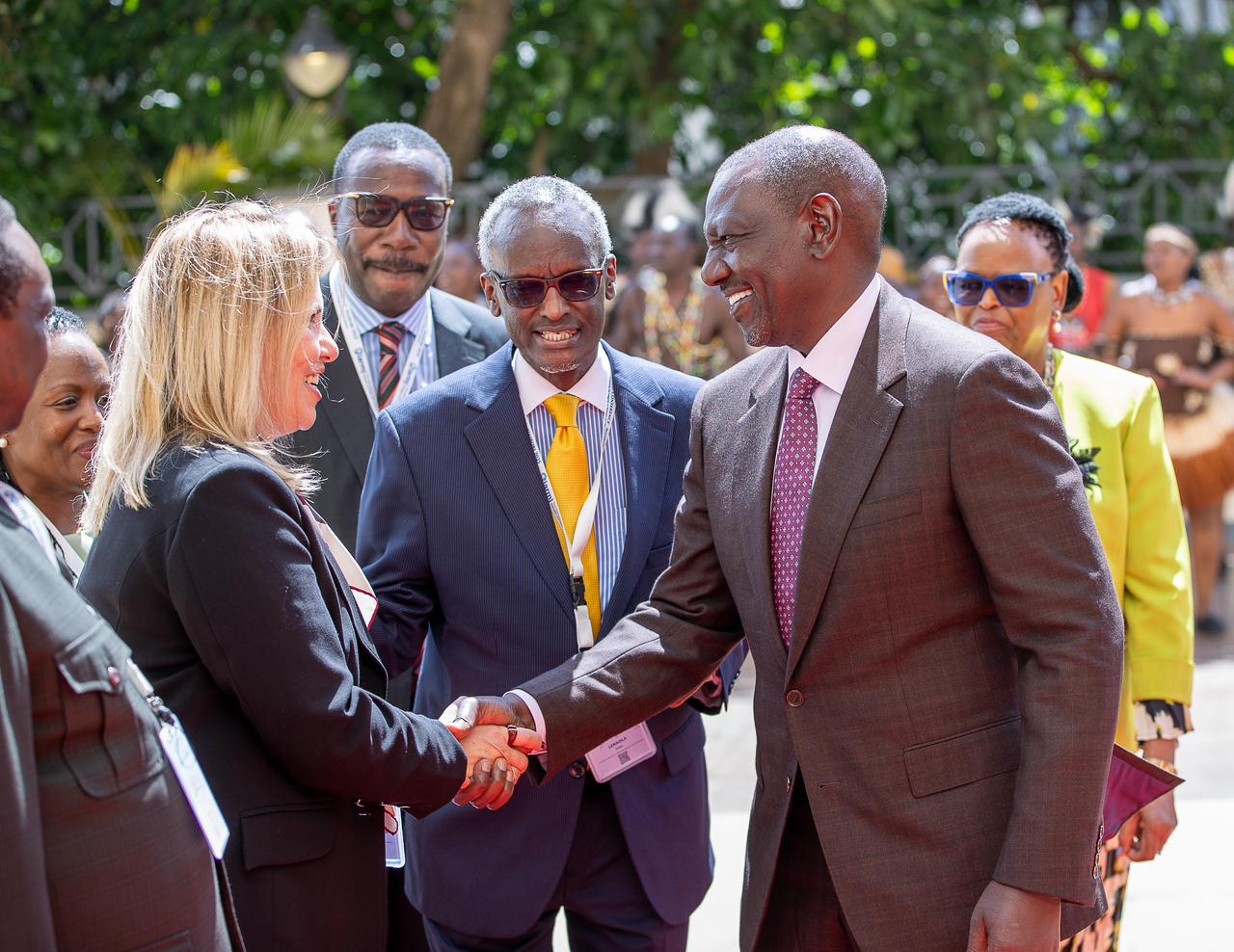
 President William Ruto Speaking during the opening of the 14th International Association of Refugee and Migration Judges (IARMJ) World Conference on November 17, 2025. Photo by PPS.


President William Ruto has urged the international community to renew its commitment to justice, human dignity, and shared responsibility as nations grapple with an unprecedented global displacement crisis.
He made the call in Nairobi during the opening of the 14th International Association of Refugee and Migration Judges (IARMJ) World Conference, where judges and delegates from across the world gathered to discuss the integrity of migration and refugee systems.
Ruto warmly welcomed the participants to Kenya, describing Nairobi as a city that reflects the country’s diversity, resilience, and generosity. He noted that the world is facing a historic moment, with over 120 million people displaced by conflict, persecution, economic instability, and climate-related disasters.
These figures, he stressed, represent real human lives disrupted by circumstances beyond their control and underscore the urgency of strengthening global refugee protection mechanisms.
The President highlighted Kenya’s longstanding commitment to hosting refugees, noting that the country currently shelters nearly 580,000 refugees and asylum seekers.
He emphasized that Kenya’s approach is grounded in the principles of humanity and international law, citing its adherence to major global and regional refugee conventions. He also pointed to the Refugees Act of 2021, which guarantees refugees the right to work, freedom of movement, and access to essential services.
Ruto spoke proudly of the newly launched Shirika Plan, a bold initiative aimed at transforming refugee camps into integrated settlements where refugees and host communities can live, work, and thrive together.
He described the plan as a shift from encampment to empowerment and a reflection of Kenya’s commitment to sustainable, people-centred refugee policies aligned with global frameworks such as the Global Compact on Refugees.
Underscoring the importance of regional peace and diplomacy, the President affirmed Kenya’s continued efforts to promote stability in South Sudan, Somalia, the Horn of Africa, and the Democratic Republic of Congo. He said that durable peace remains the most effective long-term solution to forced displacement.
Ruto devoted a significant part of his speech to the crucial role of the judiciary in refugee protection. He noted that judges often hold the power to determine whether a refugee finds safety or faces danger.
He called on judicial officers to ensure fairness, impartiality, and respect for the rule of law, emphasizing the need for harmonised interpretation of refugee laws across jurisdictions. Judicial independence, he added, is fundamental to safeguarding asylum seekers from arbitrary decisions and ensuring transparent and credible processes.
He also stressed that strong institutions, adequate resources, and proper training—including trauma-informed interviewing—are essential in building credible and fair refugee systems. Public trust, he said, depends on transparent procedures that protect genuine refugees while ensuring dignified and lawful handling of those without valid claims.
The President went on to outline emerging challenges affecting global displacement, including climate change, which is increasingly driving migration across Africa and beyond. He warned that by 2050, climate-related crises could displace more than 200 million people, calling for legal frameworks that evolve to protect these vulnerable groups.
Ruto also raised concerns about the misuse of asylum systems and the growing threats of human trafficking and migrant smuggling. He affirmed Kenya’s strengthened legal measures and regional cooperation to combat these crimes but stressed that victims should be treated with compassion, not criminalization.
Turning to technology, the President acknowledged the potential of artificial intelligence in improving asylum systems but cautioned against its unregulated use. He insisted that technology must support justice, not undermine it, and that human oversight remains indispensable.
In closing, President Ruto reaffirmed Kenya’s commitment to humane and lawful refugee management but emphasized that the global displacement crisis cannot be resolved by host countries alone. He called for stronger international solidarity, increased financial support, and expanded resettlement opportunities. Solidarity, he said, is not an act of charity but a matter of justice.
He encouraged judges attending the conference to uphold fairness, courage, and independence in their decisions, reminding them that their rulings shape lives and protect families. President Ruto then officially declared the 14th IARMJ World Conference open.