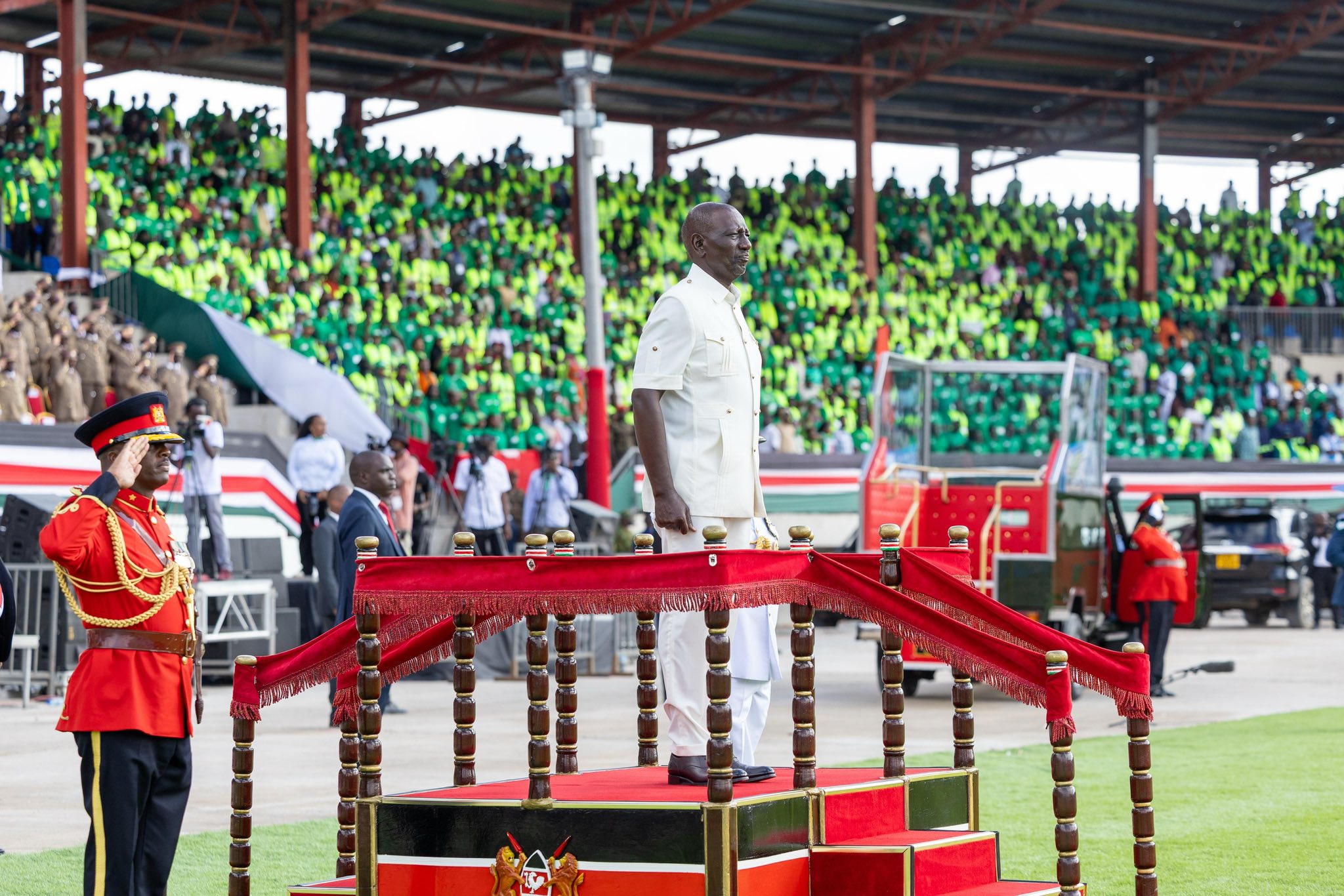
 Machakos Governor Wavinya Ndeti addressing a rally in Machakos town. Photo Courtesy


By Fredrick Kioko
Machakos Governor Wavinya Ndeti has accused the County Assembly Speaker of acting unlawfully by declaring her memorandum on the 2026 Machakos County Appropriation Bill “inadmissible”, escalating the ongoing standoff between the county executive and legislature.
In a strongly worded statement, Governor Wavinya said she returned the Appropriation Bill to the Assembly within the prescribed 14 days and argued that the Speaker had no legal authority to unilaterally reject the memorandum.
According to the governor, Section 24 of the County Governments Act requires the Governor to either assent to a Bill or return it to the County Assembly with a memorandum outlining the reasons for the rejection. She said the Assembly can then either accommodate the concerns raised or pass the Bill again with a two-thirds majority.
Wavinya said there was therefore only one lawful course of action available to the Speaker after the memorandum was received — table it before the House for debate and voting.
She accused the Speaker of “recklessly” misleading the Assembly and the public by declaring the memorandum inadmissible, warning that the decision could have lasting consequences.
The governor also turned her attention to what she described as a broader disregard for constitutionalism and the rule of law, particularly following what she termed the Speaker’s “latest assault on the media.”
Wavinya cited Articles 34, 118 and 196 of the Constitution, arguing that they protect media freedom and independence while guaranteeing public and media access to legislative proceedings. She condemned alleged threats against journalists covering Assembly proceedings and said such actions amounted to impunity.
A substantial part of the governor’s statement sought to explain the budget allocations that the Assembly reportedly questioned.
Wavinya defended the Sh126.9 million allocation for the Integrated County Revenue Management System, arguing that the digital revenue collection platform had been central to improving the county’s own-source revenue.
She said Machakos’ own-source revenue had increased from about Sh1 billion when her administration came into office to Sh1.4 billion in the first year, Sh1.5 billion in the second, Sh2.2 billion in the third and Sh3.5 billion in the fourth year.
The governor warned that defunding the revenue management system could result in revenue shortfalls that would affect other county programmes.
She also rejected the Assembly’s proposed reallocation of funds meant for roads, saying the projects had been identified through public participation and incorporated into the County Integrated Development Plan and Annual Development Plans.
Among the projects she defended were the Lita–Miti Muunza Road, Masinga–Ekalakala–Kaewa Road and Mlolongo Police–Gossip Road.
Wavinya further pointed to roads already upgraded by the county since 2013, including Makutano–Mwala–Kithimani, Kathiani–Kakuyuni–Kangundo, Kivandini–Masinga, Seveni–Kionyweni–Miu and Katangi–Malava roads.
She argued that withdrawing funds from projects already under implementation would undermine their completion, citing the Katangi–Kithimani Road, whose budget was approved by the Assembly in 2024.
The governor also defended the Sh90 million allocation proposed for the Directorate of County Administration and Decentralised Units.
She said the department had proposed Sh10.46 million for Machakos Sub-County and Sh10.23 million for each of the other eight sub-counties to facilitate the delivery of government services closer to residents.
According to Wavinya, the Assembly’s decision to cut each sub-county’s allocation by about Sh9.67 million would leave the units with less than Sh500,000 for an entire financial year.
She dismissed claims that county officials had failed to provide information requested by Assembly committees, saying her officers appeared before the General Oversight Committee and provided the requested documentation.
Wavinya further disputed claims that the county lacked a legal framework to support its Sh78.32 million urban development allocation.
She said the county had an existing legal and policy framework allowing it to contract private service providers for defined solid-waste management services while retaining responsibility for planning, regulation, supervision, contract management and accountability.
She cited the County Governments Act, the National Sustainable Waste Management Policy 2019, the Machakos County Environmental Management Act 2022, as well as contractual and terms-of-reference documents as part of the framework.
The governor also rejected claims that Machakos lacked policies and strategies for receiving and utilising climate funds.
She listed several frameworks, including the Public Finance Management Act, Climate Change Act 2016, Climate Change Regulations, National Climate Finance Policy 2018, National Green Fiscal Incentive Framework Policy 2024, Paris Agreement and the Machakos County Integrated Development Plans.
On the Machakos Youth Service (MYS), Wavinya said the Machakos Empowerment Policy provided the statutory framework for youth and community empowerment, alongside the Youth Empowerment Act 2022 and other county planning instruments.
She said MYS had helped transform vocational training centres into employment and skills-development hubs through improved infrastructure, equipment, instructor capacity and access to market-relevant skills.
The governor also defended increased bursary allocations, saying bursaries were a statutory obligation and an important pillar of inclusive education under the county’s development plans.
Wavinya concluded by urging members of the County Assembly to “stand on the right side of history” and respect what she described as their obligation to serve Machakos residents without selfish interests.
She maintained that under Section 24(3) of the County Governments Act, the Assembly’s lawful options after receiving her memorandum were to amend the Bill in line with her concerns or pass it without amendment through the required majority.