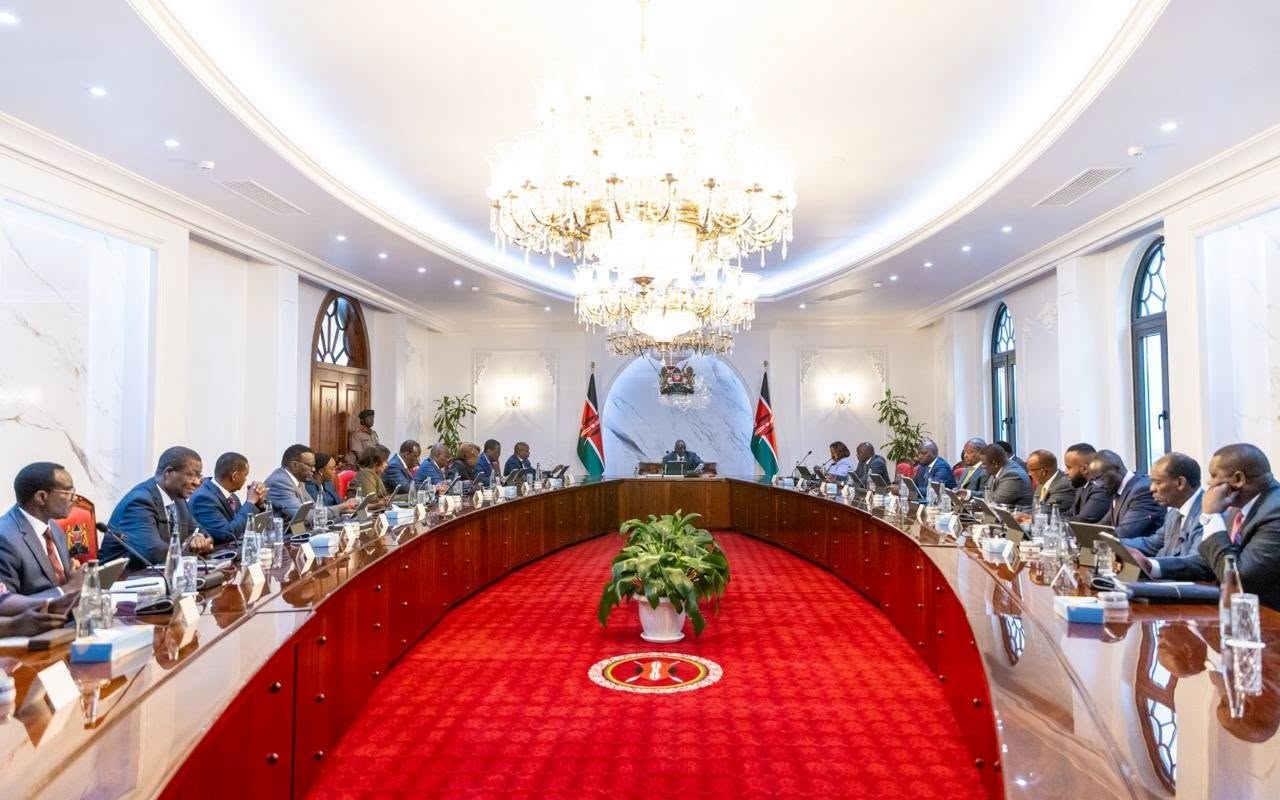
 President William Ruto chaired a Cabinet meeting at State House, Nairobi, where ministers approved a series of policy, infrastructure and governance measures aimed at strengthening the economy, improving public services and enhancing accountability.


By Fredrick Kioko,
President William Ruto chaired a Cabinet meeting at State House, Nairobi, where ministers approved a series of policy, infrastructure and governance measures aimed at strengthening the economy, improving public services and enhancing accountability.
Among the key resolutions was the approval of petroleum cooperation agreements with Rwanda and South Sudan, allowing the two neighbouring countries to import bulk refined petroleum products through Kenya's Government-to-Government (G-to-G) fuel import framework. The move is expected to reinforce Kenya's position as a regional energy hub.
The Cabinet also ordered investigations into suspected payroll fraud after an audit of 12 State departments uncovered irregularities amounting to KSh6.2 billion. The Directorate of Criminal Investigations (DCI) has been tasked with probing the matter, while the government will migrate institutions to an upgraded Integrated Human Resource and Payroll System and strengthen cybersecurity to prevent future fraud.
In the Judiciary, Cabinet approved the construction of a new Supreme Court complex, a dedicated Court of Appeal building and a modern Kenya Judiciary Academy. It also sanctioned KSh26 billion for the second phase of the Judicial Performance Improvement Project in partnership with the World Bank to enhance access to justice and improve court efficiency.
The government further authorized KSh16.6 billion to complete the Mwache Multipurpose Dam in Kwale County, a project expected to boost water supply, irrigation and flood control. Funding was also approved for key sections of the Isiolo-Mandera road corridor to improve connectivity, trade and security in Northern Kenya.
To strengthen disaster preparedness, Cabinet established an Ad Hoc Committee on El Niño Preparedness chaired by Deputy President Kithure Kindiki. The committee will coordinate national preparations for the anticipated heavy rains.
Recognizing the growing importance of emerging technologies, Cabinet also approved the formation of a Standing Cabinet Committee on Artificial Intelligence. The committee will oversee the country's AI strategy, policy development and adoption of artificial intelligence across government.
In the health sector, Cabinet approved the Kenya-United States Health Cooperation Framework to strengthen collaboration in the fight against HIV/AIDS, malaria and tuberculosis while supporting the development of a more self-reliant healthcare system.
The meeting also approved a KSh4.5 billion partnership with Amsons Group to construct 10 specialized Mother and Child hospitals across the country, alongside the KSh7.8 billion second phase of the Kenya-Austria Mother and Child – Our Future Project.
To spur job creation, Cabinet adopted the National Business Process Outsourcing (BPO) Policy, which seeks to attract investment into Kenya's digital economy and create thousands of employment opportunities for young people.
The manufacturing sector also received a boost after Cabinet endorsed the KSh5.8 billion Leather Value Chain Development Support Project and approved the establishment of the Kenya Leather Development Authority to strengthen regulation, value addition and competitiveness in the leather industry.
Additionally, Cabinet approved the Protection Against Domestic Violence (Amendment) Bill, 2026, which seeks to strengthen legal protections for survivors of domestic violence and enhance enforcement of existing laws.
The resolutions underscore the government's focus on infrastructure development, healthcare, digital transformation, economic growth, public sector accountability and social protection as part of its broader national development agenda.