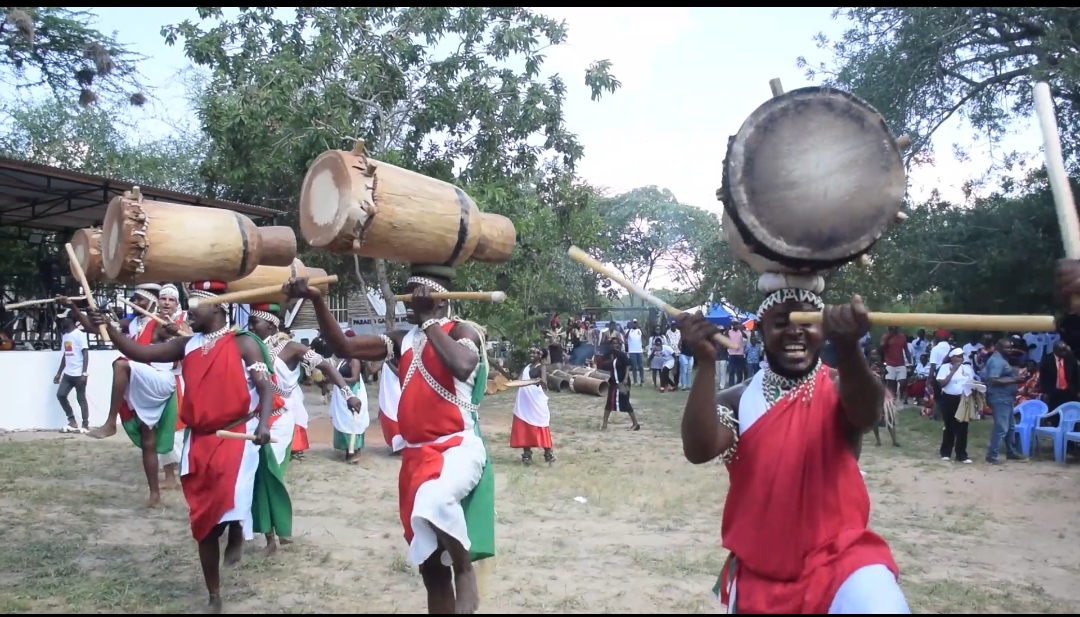
 A Burundian troupe that delivered one of the day’s most electrifying performances during a Kamba traditional festival at Akamba Cultural Center and Museum on March 4, 2026. Photo by Mutune Ngumu.


By Andrew Mbuva and Mutune Ngumu
Music, colour and rhythm engulfed Uvilisyani Village in Makueni County on Saturday as traditional dancers and cultural enthusiasts converged for a vibrant festival aimed at reviving and celebrating the rich heritage of the Akamba people.
The event, initially designed to spotlight endangered Kamba dances, evolved into a broader cultural showcase, drawing performers from neighbouring Taita Taveta County and beyond in a spirited display of unity through tradition.
At the heart of the festival was the Akamba Cultural Center and Museum, whose proprietor, Mutuku Muindi, described the gathering as a critical step toward restoring a heritage at risk of fading away.
“We are setting the stage to celebrate the culture of the Akamba people because culture defines who we are,” he said. “If a person does not know where they come from, they cannot know where they are going. This is a great awakening for our culture and for the dancers of Eastern Kenya.”
Muindi noted that many traditional performers have passed on over the years, leaving a gap that the festival seeks to bridge by rekindling interest and participation among communities.
The celebration drew admiration from both local and international participants. Elizabeth Nyaberi, a member of a Burundian troupe that delivered one of the day’s most electrifying performances, hailed the initiative as timely and necessary.
“In this generation, it is rare to find custodians of culture. I am happy because we are restoring what was lost along the way,” she said.
Former Makueni Governor, Kivutha Kibwana, used the platform to call for a deliberate integration of culture into national development. He emphasized the need for Kenya’s diverse communities to identify and preserve their unique cultural “DNA” while building a shared national identity.
“We must return to our cultural roots even as we pursue modern development models,” he said. “Every community has valuable traditions that can contribute to a collective Kenyan culture.”
However, concerns emerged over the apparent disconnect between cultural events and the younger generation. Culture enthusiast Kanini Mutisya questioned the low turnout of youth, warning that traditions risk extinction if not actively passed down.
“Where are the young people? Are they not interested, or are we failing to pass this knowledge to them?” she posed. “We must ensure that this generation has something meaningful to pass on.”
The festival also resonated deeply with international attendees. Nathan Fallou, a Nairobi-based participant, expressed excitement at finally experiencing authentic Kenyan rhythms, which he said many locals seemed unfamiliar with.
“I’ve often asked about Kenya’s drumming traditions and rhythms, and many people don’t know them,” he said. “Today, I discovered something powerful—these rhythms carry meaning and connect deeply with the body. This is something the world needs to see.”
The highlight of the day was a captivating performance by the Burundian troupe, whose high-energy display drew cheers and underscored the festival’s growing role as a hub for cross-cultural exchange.
As the drums faded and dancers took their final bows, one message stood clear: preserving culture is not just about remembering the past—it is about securing identity for future generations.