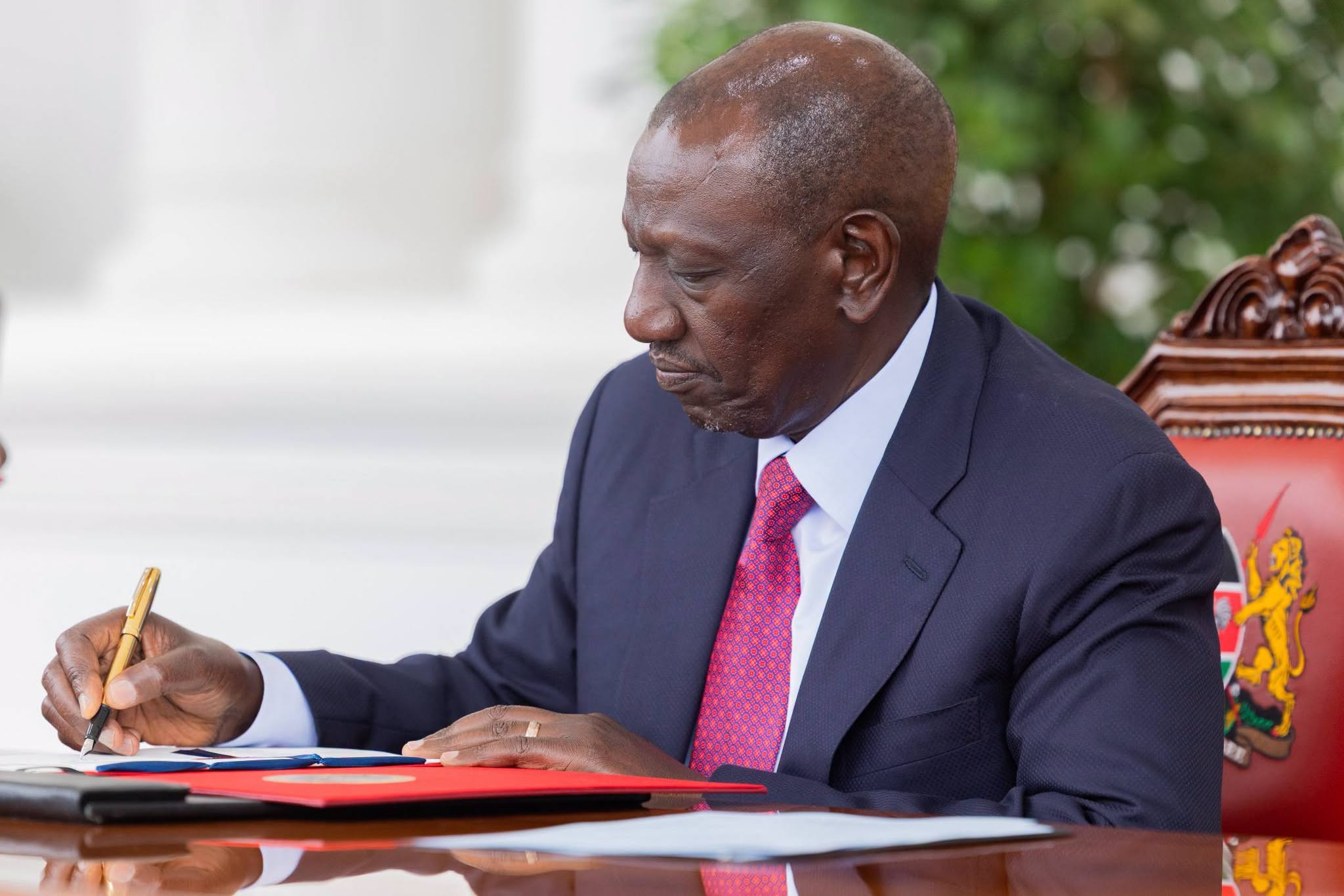
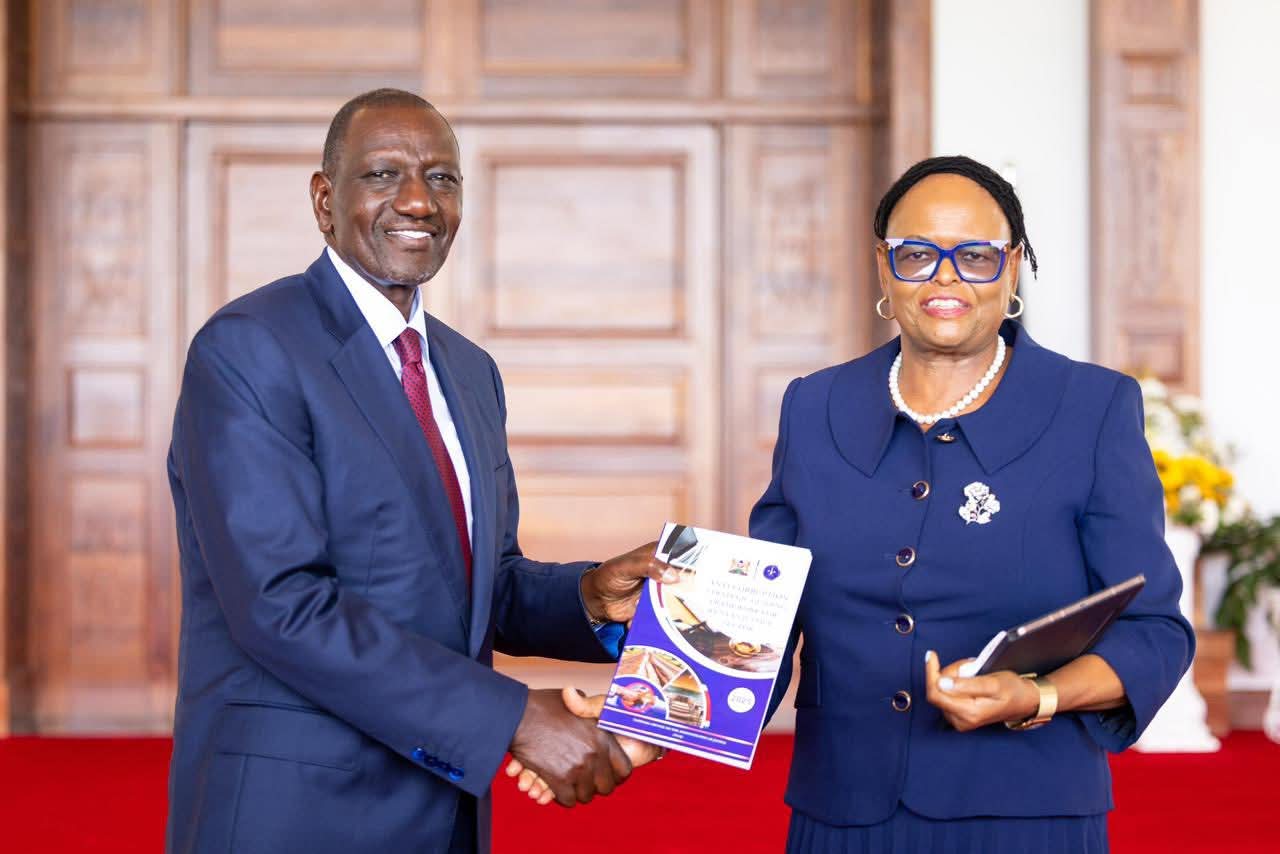
 President William Samoei Ruto and Chief Justice Martha Koome during the presentation of a report by the National Council on the Administration of Justice (NCAJ) at State House on March 2, 2026. Photo by PCS


By Andrew Mbuva
President William Samoei Ruto has announced sweeping legal, digital, and institutional reforms aimed at tackling Kenya’s worsening road safety crisis, describing the rising number of traffic deaths as a “grave national concern” that the country can no longer ignore.
Speaking at State House, Nairobi, during the presentation of a report by the National Council on the Administration of Justice (NCAJ), the President revealed that more than 5,000 Kenyans lost their lives on the roads last year — 261 more than in 2024 — pushing annual fatalities beyond 4,000 for consecutive years.
“These accidents and the injuries and deaths they occasion continue to exact a heavy and unacceptable toll on our nation,” the President said.
Beyond the human tragedy, President Ruto noted that road crashes cost Kenya approximately five percent of its Gross Domestic Product annually — an estimated KSh450 billion. During the 2025 festive season alone, 415 fatalities were recorded, marking a 23 percent increase from the previous year.
The grim statistics have prompted the government to transition from piecemeal interventions to a coordinated, whole-of-government approach.
For the first time, a multi-agency traffic justice model was piloted during the 2025/2026 festive season under the NCAJ framework. The initiative brought together enforcement officers, prosecutors, and judicial officers in a unified system.
The pilot saw the deployment of 36 prosecutors, 40 officers from the Ethics and Anti-Corruption Commission (EACC), and 121 officers from the National Transport and Safety Authority (NTSA), significantly strengthening enforcement.
As a result, fatalities involving Public Service Vehicles (PSVs) dropped by 10 percent — a sign, the President said, that coordinated enforcement can deliver measurable results.
However, the report also revealed shifting patterns of risk. Accidents involving private vehicles have risen, alongside night-time crashes involving long-distance trucks. Boda boda-related accidents remain a persistent and serious threat.
Within the justice chain, the pilot exposed systemic weaknesses including weak enforcement, bribery across the enforcement chain, lenient penalties, poor inter-agency coordination, and gaps in post-crash response.
Other contributors include reckless driving, speeding, drunk driving, poor driver training standards, unlicensed riders, unroadworthy vehicles, counterfeit spare parts, and unsafe road design. Economic pressures on PSV operators were also cited as fueling risky behaviour.
Virtual traffic courts recorded only a 25 percent success rate due to connectivity and power challenges, while budget constraints slowed the rollout of mobile courts. Delays between arrest and case registration at the Office of the Director of Public Prosecutions further weakened deterrence.
To reverse the trend, President Ruto outlined a comprehensive reform package.
Key proposals include amendments to the Traffic Act to introduce instant fines and a demerit points system for driving licences, standardisation of driver training and licensing, and fast-tracking of the NCAJ Bill.
On digital transformation, the government plans to establish an integrated e-transport and traffic case management system linking all relevant agencies. Automated ticketing will be scaled up alongside expanded deployment of CCTV and speed cameras, and the creation of a secure digital evidence management framework.
To curb corruption, the report recommends the deployment of body-worn cameras for traffic officers, continuous vetting and integrity testing, and enhanced anti-bribery mechanisms.
The President also directed non-justice sector agencies to fast-track the identification and redesign of accident blackspots, particularly along major highways such as the Northern Corridor and the Mombasa–Nairobi Highway. Future road projects will adopt safety-by-design principles, while pedestrian walkways, crossings, and dual carriageways will be expanded.
Mandatory vehicle and motorcycle inspections will be strengthened, digital fatigue monitoring systems such as tachographs introduced, and PSV operators required to obtain defensive driving certification. Boda boda operations will be formalised under SACCO structures.
To improve survival rates after crashes, the government plans to establish additional trauma centres and ambulance response points along major highways, strengthening the “Golden Hour” emergency response framework.
President Ruto emphasised that road safety reform must now move from pilot phase to full national transformation.
“Sustained high-level political leadership is indispensable. Road safety must be pursued through a whole-of-government and whole-of-society approach,” he said, adding that the operationalisation of the National Road Safety Fund would provide dedicated financing for the reforms.
Declaring that Kenya cannot accept the continued loss of lives on its roads, the President affirmed the government’s commitment to implementing the recommendations decisively and without delay.
“We cannot, and we will not, accept the continued loss of Kenyan lives on our roads,” he said.