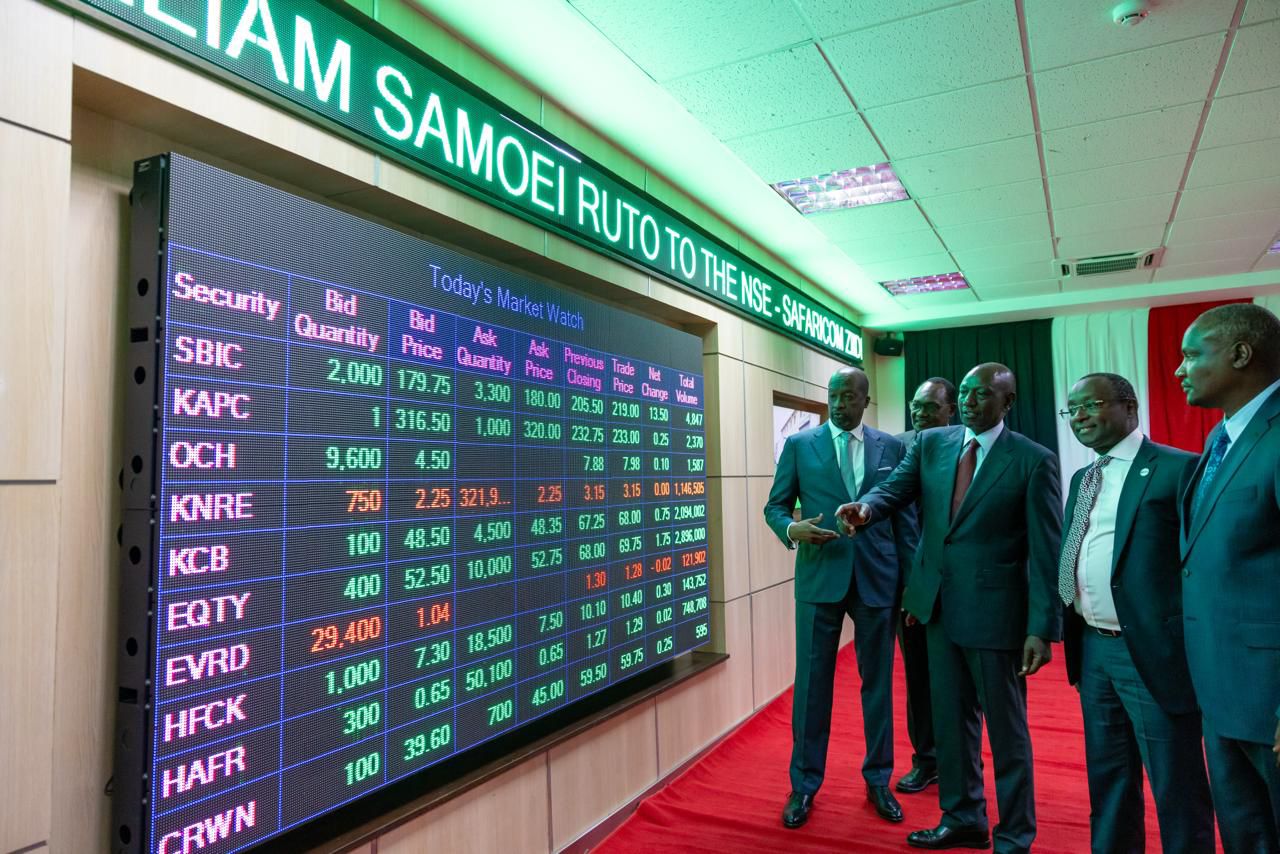
 President William Ruto during the official launch of the Ziidi Trader at Nairobi Securities Exchange (NSE),Nairobi on February 10, 2026. Photo by PS


By Andrew Mbuva.
President William Ruto has launched the Safaricom Ziidi Trader platform, hailing it as a transformative innovation that will widen investment opportunities and strengthen Kenya’s capital markets by enabling millions of citizens to trade shares and bonds directly through the M-PESA platform.
Speaking during the launch at the Nairobi Securities Exchange (NSE) on Tuesday, the President described the platform as a milestone in the country’s efforts to democratise access to financial services, enhance inclusion, and empower Kenyans to build wealth through investment.
The Ziidi Trader platform integrates stock trading into M-PESA, allowing users to conveniently buy and sell shares, bonds, and other securities listed on the NSE. President Ruto said the innovation would particularly benefit youth and women by removing long-standing barriers that have historically limited their participation in capital markets.
“This platform represents a decisive turning point in how citizens engage with the stock exchange by bringing investment opportunities closer to all Kenyans,” the President said.
Ruto noted that the initiative aligns with his administration’s commitment to strengthening financial markets as a critical pillar for economic growth. He recalled that shortly after assuming office in 2022, he challenged capital market stakeholders to leverage technology to widen public participation, adding that the Ziidi Trader platform demonstrates the success of collaboration between government and the private sector.
The President further reiterated the government’s plan to revitalise capital markets through a structured privatisation programme aimed at encouraging public listing of state-owned enterprises. He noted that Kenya has not undertaken a major privatisation since the listing of Safaricom in 2008, a gap he said has slowed the expansion and liquidity of local financial markets.
He cited the ongoing privatisation of the Kenya Pipeline Company as part of broader reforms intended to attract private sector investment and unlock long-term development capital. According to the President, funds generated from such divestitures will be channelled through the National Infrastructure Fund and the Sovereign Wealth Fund to finance national development priorities while safeguarding future generations.
Ruto outlined the government’s ambitious 10-year development agenda, which includes the construction of 2,500 kilometres of dual carriage highways, tarmacking 28,000 kilometres of roads, expanding electricity generation capacity from 3,300 megawatts to 10,000 megawatts, and developing an extensive irrigation infrastructure comprising 50 mega dams, 200 mini dams, and 1,000 micro dams.
He emphasised that the government intends to mobilise nearly KSh5 trillion to fund these projects without increasing the tax burden or accumulating unsustainable public debt, adding that capital markets would play a crucial role in achieving this objective.
The President also pointed to recent improvements in the performance of the NSE, noting that market capitalisation grew by approximately 48 per cent last year, rising from KSh1.968 trillion to about KSh3 trillion. He attributed the growth to improved macroeconomic stability, including lower interest rates, a more stable currency, and stronger policy coordination, which he said had boosted investor confidence.
He concluded by congratulating Safaricom and capital market stakeholders for advancing Kenya’s financial sector and reaffirmed the government’s commitment to building efficient, inclusive, and globally competitive financial markets.
The launch of the Ziidi Trader platform is expected to accelerate retail investor participation in Kenya’s stock market and position the NSE as a more accessible and technology-driven investment hub.