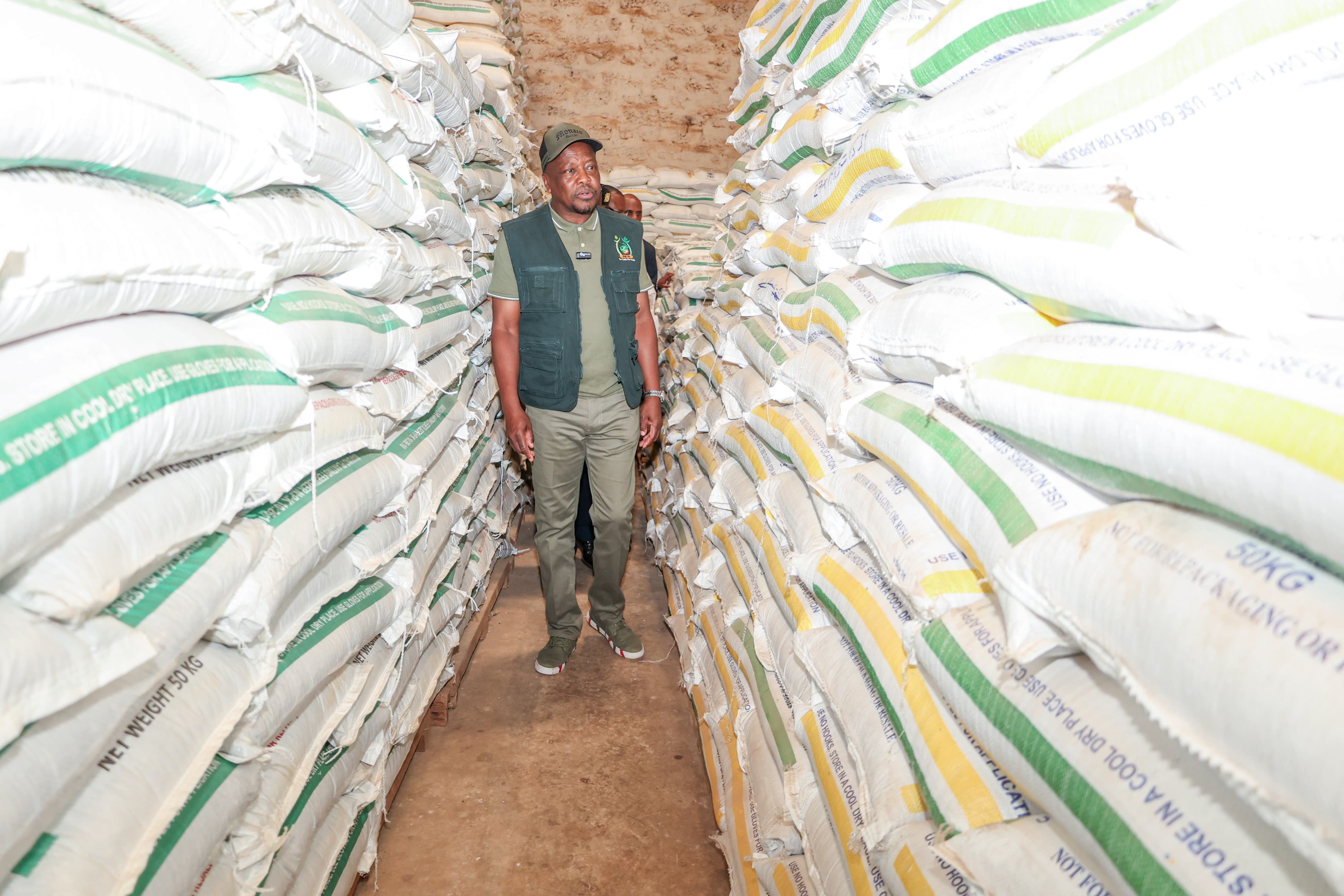
 Cabinet Secretary for Agriculture and Livestock Development, Mutahi Kagwe tours the National Cereals and Produce Board. Photo Courtesy.


By Andrew Mbuva
The Cabinet Secretary for Agriculture and Livestock Development, Mutahi Kagwe, has issued a one-month ultimatum to maize hoarders to release their stocks into the market, warning that the Government will open the door to duty-free maize imports if the shortage persists.
Speaking on measures to stabilise maize flour prices, CS Kagwe said the Government’s priority remains buying maize from local farmers to replenish the National Strategic Food Reserves. However, he cautioned that imports would be unavoidable if adequate supplies are not delivered within 30 days.
“We are buying maize at KSh 4,000 per bag and we have KSh 1.7 billion ready for payment. Our first option is not to import; it is to buy from our farmers. But as a country, we must stock our reserves and be prepared for emergencies,” he said.
The Government is targeting an immediate purchase of 1.7 million bags of maize, with a long-term goal of building a 4 million-bag Strategic Grain Reserve. So far, only 186,000 bags have been delivered, a shortfall the CS attributed to hoarding and speculative practices, particularly as drought conditions begin to emerge in parts of the country.
To curb post-harvest losses and address quality challenges, CS Kagwe announced the rationalisation of over 60 mobile and immobile maize dryers across the country. He said dryers would be urgently redeployed to cooperatives, large-scale farmers, self-help groups, and high-production zones, while those stationed in low-yield areas would be withdrawn.
“Aflatoxin is a serious public health issue. Taking dryers to areas with little or no maize is a misuse of national resources,” he said.
Farmers will be allowed to dry maize at National Cereals and Produce Board (NCPB) facilities at minimal maintenance costs, while millers will be permitted to lease dryers to reduce rejection of locally produced maize and curb dependence on imports from neighbouring countries.
CS Kagwe noted that the fertilizer subsidy programme has already delivered tangible results, with maize production doubling during the 2025 season following the distribution of 9.1 million bags of assorted fertilizers, aided by favourable weather in the Rift Valley, Eastern, and Central regions.
To address last-mile distribution challenges, county governments will now register agro-dealers, enabling farmers to access subsidised fertilizer closer to their farms. The Ministry is also working with the National Treasury, the World Bank, and commercial banks to roll out an instant payment system to ensure agro-dealers are paid immediately upon voucher redemption.
On rice, the CS dismissed claims of a national shortage, saying Kenya produces about 20 per cent of its rice needs and that NCPB has the capacity to mill more. He reiterated that imports will not be allowed before locally produced rice and wheat are fully taken up.
“Food security is not optional. It is a national duty,” CS Kagwe said, reaffirming the Government’s commitment to import substitution and strengthened strategic reserves.