
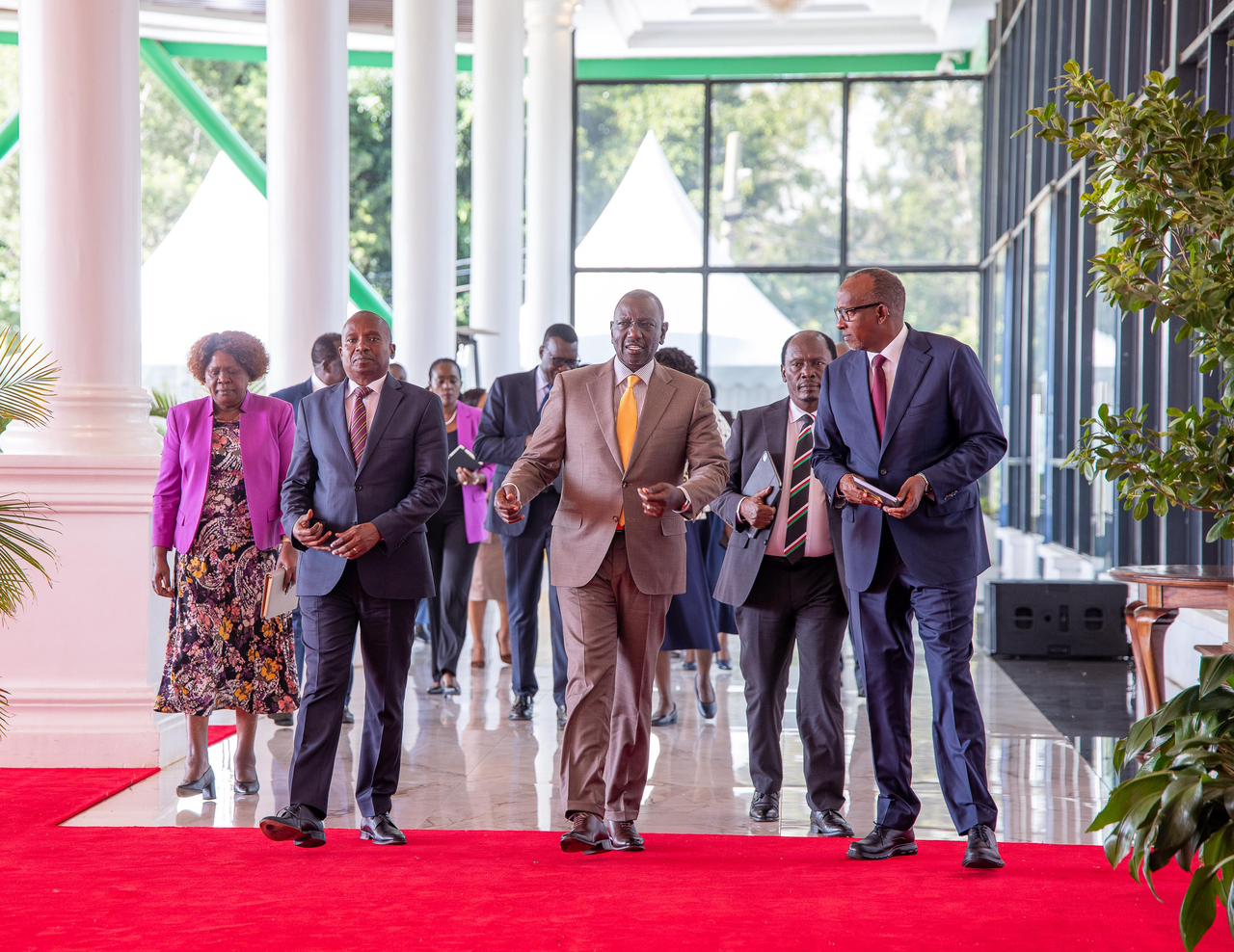
 From Left: Deputy President Kithure Kindiki, President William Ruto and Health Cabinet Secretary Aden Duale during today's Cabinet Meeting. Photo by PCS


By Andrew Mbuva
Kenya has taken a decisive step toward long-term economic transformation after the Cabinet approved the establishment of two powerful financing vehicles—the National Infrastructure Fund and the Sovereign Wealth Fund—designed to anchor the country’s ambitious KSh5 trillion development agenda.
Meeting at State House, Nairobi, the Cabinet endorsed the creation of the National Infrastructure Fund as a limited liability company that will serve as the central engine for aligning public finances with national development priorities.
The Fund will mobilise domestic resources, monetise mature public assets, deploy national savings and democratise ownership through capital markets, with the aim of crowding in large-scale private capital while reducing reliance on public borrowing and taxation .
Under the new framework, all proceeds from privatisation will be ring-fenced and invested strictly in public infrastructure projects that generate long-term value. Government projections indicate that every shilling invested through the Fund could attract up to ten additional shillings from long-term investors, including pension funds, sovereign partners, private equity firms and development finance institutions .
Alongside this, the Cabinet approved the Sovereign Wealth Fund Policy, establishing a robust framework for managing revenues from mineral and petroleum resources, dividends from public investments and a portion of privatisation proceeds.
Anchored on inter-generational equity, fiscal resilience and strategic commercial investments, the Sovereign Wealth Fund aims to protect the economy from external shocks while strengthening long-term national competitiveness, in line with Article 201 of the Constitution and the Kenya Kwanza administration’s investment-led growth agenda.
Together, the two funds will finance Kenya’s transformation priorities, with a strong focus on food security, modern transport and logistics, and expanded energy generation. The government plans to boost agricultural productivity through large-scale irrigation, including the construction of 50 mega dams, 200 mini-dams and more than 1,000 micro-dams, bringing an additional 2.5 million acres under production and uplifting rural livelihoods.
Infrastructure expansion will see the dualling of 2,500 kilometres of highways, tarmacking of 28,000 kilometres of roads, extension of the Standard Gauge Railway to Malaba, expansion of regional oil pipelines and modernisation of ports and airports to strengthen regional and global connectivity .
To power industrialisation and the digital economy, Kenya will add at least 10,000 megawatts of new energy capacity over the next seven years, drawing on geothermal, hydro, solar, wind and nuclear sources.
Both funds will be professionally and independently managed under strict governance, transparency and accountability frameworks, signalling a decisive shift toward a sustainable, investment-driven development model that seeks to secure lasting prosperity for present and future generations .