
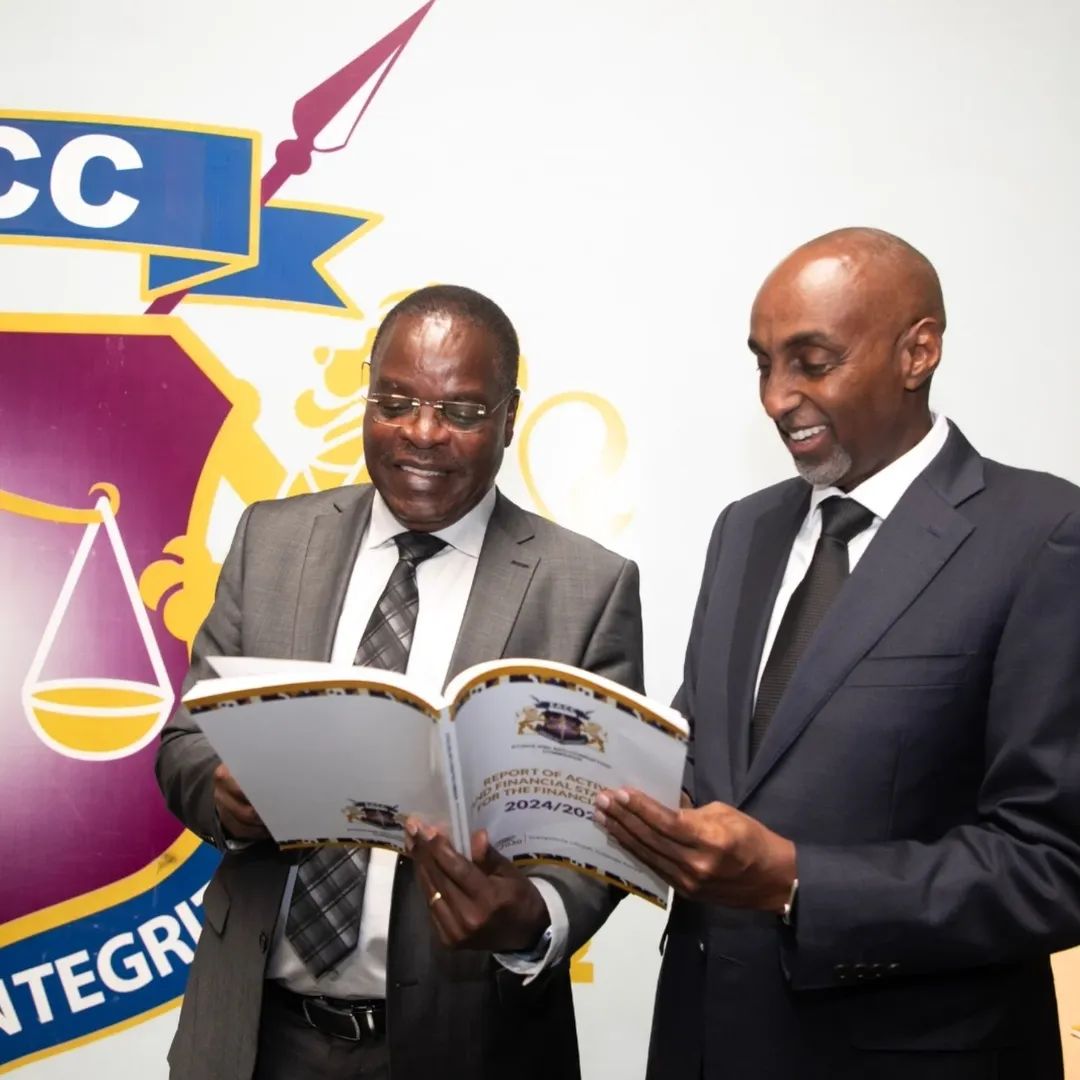
 The Ethics and Anti-Corruption Commission (EACC) Chair Dr. David Oginde and the Chief Executive Officer Abdi Mohamud during the Launch of the 2024/2025 Annual Report. Photo Courtesy


By Andrew Mbuva
The Ethics and Anti-Corruption Commission (EACC) has unveiled its 2024/2025 Annual Report, highlighting significant progress in the national fight against corruption while underscoring critical challenges that continue to undermine governance efforts.
The report was launched today at the Integrity Centre by EACC Chairperson Dr. David Oginde, flanked by Commissioners and Chief Executive Officer Abdi Mohamud. According to the Commission, the year under review marked some of the strongest gains in recent years across enforcement, asset recovery, and public education.
EACC revealed that it filed 79 asset recovery suits—the highest number recorded in the last five years—targeting property valued at KSh4.8 billion. Out of this, the Commission successfully recovered KSh3.4 billion in stolen assets.
The agency further reported that through timely intelligence operations, it managed to avert potential losses amounting to KSh16.5 billion, preventing public resources from falling into corrupt hands.
Convictions also rose sharply, jumping from 12 in the previous year to 33, signalling a notable improvement in both investigations and collaboration with prosecutorial agencies. The Commission noted that strengthened multi-agency partnerships and increased youth-focused integrity campaigns played a pivotal role in boosting the overall performance.
However, despite these achievements, EACC cautioned that the war on corruption continues to face major obstacles. Weak enforcement of Chapter Six of the Constitution, interference with witnesses, intimidation of anti-corruption officers, fragmented institutional cooperation, and rising public apathy were cited as persistent threats undermining the integrity agenda.
With Kenya set to commemorate International Anti-Corruption Day on December 9th, the Commission called for renewed national resolve, urging citizens, institutions and leaders to embrace collective responsibility in safeguarding public resources.
Dr. Oginde emphasized that while progress is evident, sustainable success requires unity, vigilance and unwavering commitment to ethical leadership. “The fight against corruption is not the duty of institutions alone—it is a shared obligation,” he said.
The Commission reiterated its dedication to strengthening accountability mechanisms as it continues to pursue justice, restore public trust and uphold the values of integrity enshrined in the Constitution.