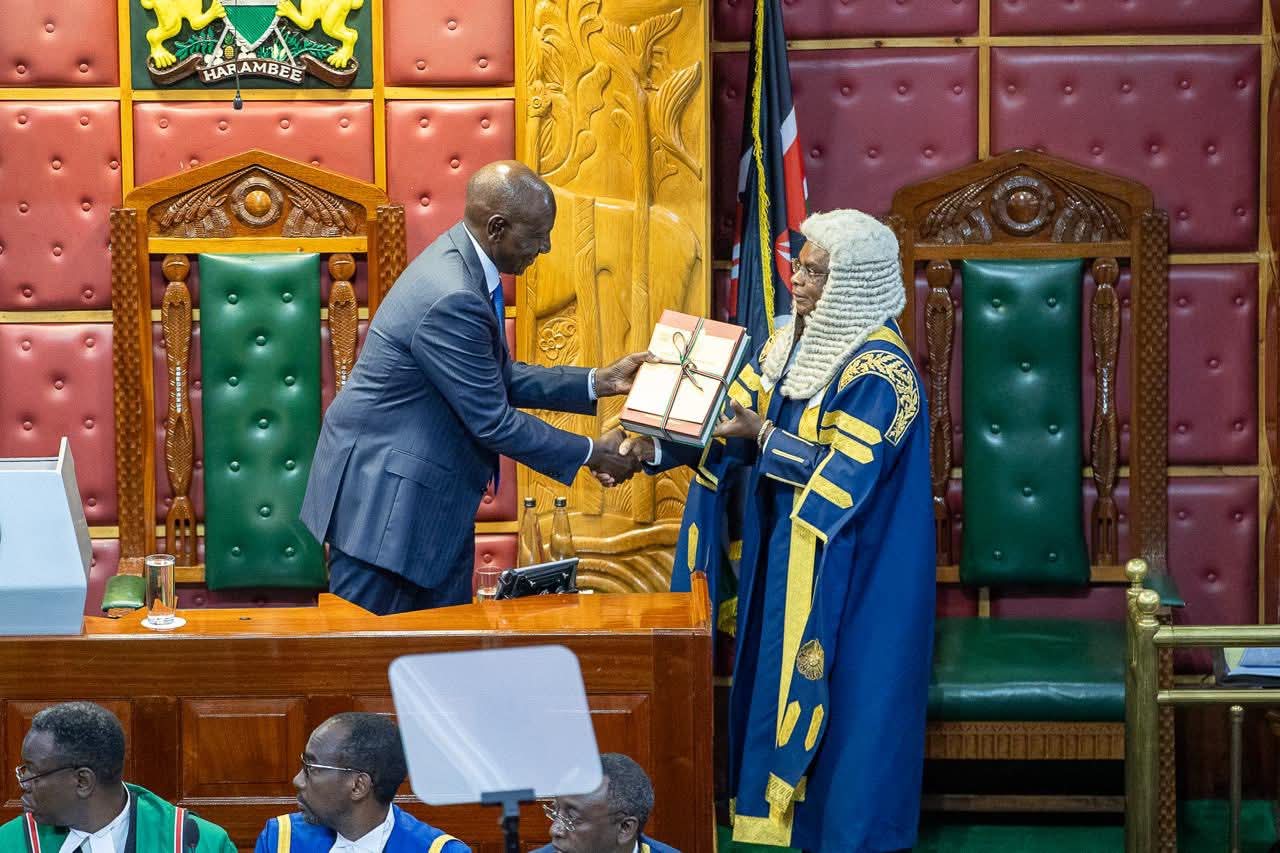
 President William Ruto during the State of Nation Address in Parliament on November 20, 2025. Photo by PPU


By Andrew Mbuva
President William Ruto has outlined an ambitious KSh 5 trillion blueprint he says will position Kenya on an irreversible path toward “first world status,” anchored on four bold national priorities spanning human capital development, energy expansion, food security, and world-class transport infrastructure.
Addressing Parliament during the State of the Nation Address yesterday, President Ruto said the plan represents “the next frontier of our national transformation—one that demands vision, discipline, and bold investments that will pay dividends for generations.”
At the heart of the strategy is a shift toward a knowledge-driven economy. The President announced the creation of a new State Department for Science, Research, and Innovation, with a pledge to increase research funding from the current 0.8% to 2% of GDP—amounting to KSh 1 trillion over the next decade.
“We must invest in the creativity and ingenuity of our people. This is the foundation upon which global competitiveness is built,” Ruto said. The government will promote STEM education, innovation hubs, and enterprise creation to stimulate a thriving knowledge economy capable of creating high-quality jobs.
To eliminate the country’s heavy dependence on imports—especially food—the President unveiled a plan to transform agricultural productivity by constructing 50 mega dams, 200 medium dams, and thousands of micro-dams.
This water infrastructure will support the irrigation of 2.5 million acres, significantly reducing the KSh 500 billion annual food import bill. Ruto said the goal is to “secure our food sovereignty” and convert Kenya from a net importer to a competitive exporter of agricultural products.
Ruto also announced a transformative energy agenda that seeks to generate an additional 10,000 megawatts of electricity within seven years. The expansion will draw from geothermal, wind, solar, hydro, and—eventually—nuclear power.
“This energy will power our industries, advance e-mobility, and attract global data centres seeking reliable green energy,” he said, underscoring Kenya’s ambition to become Africa’s clean-energy hub.
To boost trade, manufacturing, and connectivity, the President revealed a massive transport network expansion. The plan includes 2,500 kilometres of highway dualing and the tarmacking of 28,000 kilometres of roads across the country.
Major projects set for execution include the Rironi–Naivasha–Nakuru–Mau Summit dualing, the Machakos–Mariakani corridor, and the Mau Summit–Kericho–Kisumu route. In aviation and maritime sectors, Jomo Kenyatta International Airport (JKIA) and the ports of Mombasa and Lamu will undergo modernisation through public-private partnerships.
Additionally, Ruto announced that the Standard Gauge Railway (SGR) extension from Naivasha to Kisumu and onwards to Malaba will commence in January 2026—a move expected to dramatically cut cargo movement costs and integrate the region’s logistics.
To actualise the multitrillion-shilling dream without worsening national debt, the President unveiled two major funding instruments.
First is the National Infrastructure Fund, which will ring-fence all privatisation proceeds for development projects and deploy them with a 1:10 leverage ratio. “We want to attract pension funds, private equity, and sovereign investors, using models that have succeeded in nations like Singapore and Australia,” Ruto said, citing Temasek and Australia’s Future Fund as benchmarks.
Second is the establishment of a Sovereign Wealth Fund, sourced from natural resource royalties and privatisation receipts. The Fund will focus on savings, stabilisation, and infrastructure investment, ensuring what Ruto called “true intergenerational equity.”