
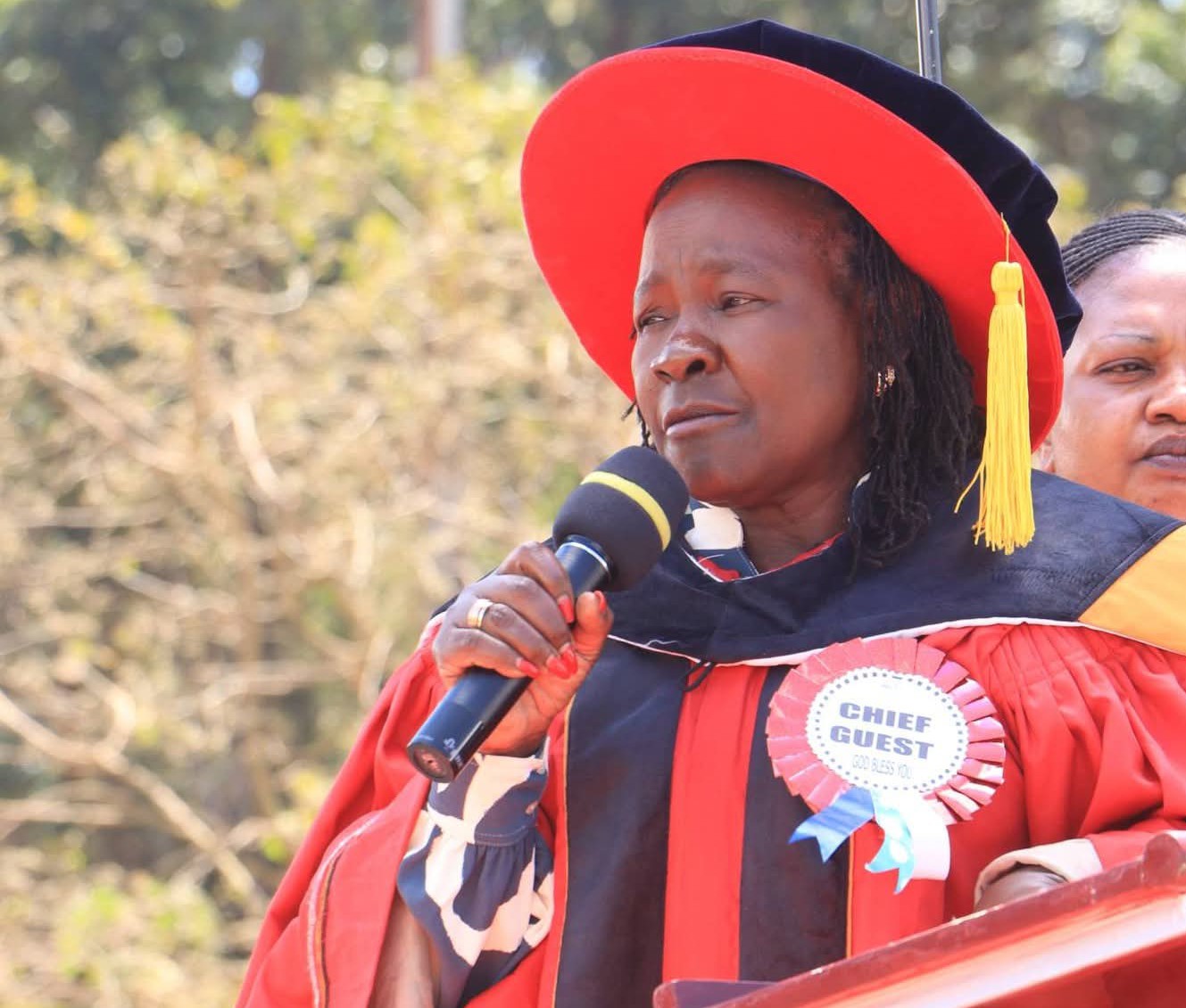
 Principal Secretary for the State Department for Technical, Vocational Education and Training (TVET), Dr Esther Muoria Thaara speaking at Kaelo Technical and Vocational College during the institution’s inaugural graduation ceremony on September 26, 2026. Photo by Dennis Dibondo.


By Dennis Dibondo
Principal Secretary for the State Department for Technical, Vocational Education and Training (TVET), Dr Esther Muoria Thaara, has challenged Kenyans to take technical training seriously, saying the sector holds the key to accelerating industrialisation and economic growth.
Dr Muoria said Kenya must strengthen the link between TVET institutions and industry by ensuring that trainees acquire practical skills that directly respond to the needs of the job market.
She said the era when students attended TVET institutions merely to obtain certificates without acquiring practical skills must come to an end.
“Young people should not just go to TVET institutions and get certificates; they should have skills and help our country economically,” Dr Muoria said.
According to the PS, Kenya should adopt an industry-driven training model similar to what she said is being implemented in Ethiopia and Rwanda, where training is designed around the needs of existing and emerging industries.
“By that I mean we should identify what our industry needs and train so they can go there straight or start their own industries according to the existing industries,” she said.
Dr Muoria warned that Kenya risks falling behind its regional peers if it fails to become more deliberate in linking technical training with economic opportunities.
“Rwanda was far much behind because of the genocide, but today it is above Kenya because they are very intentional about what they want to do. Ethiopia is also going to leave Kenya behind if we are not careful with our intentionality,” she said.
She cited agriculture as one of the sectors where TVET institutions can play a major role by producing goods for local consumption and export.
She noted that institutions such as Nyandarua Polytechnic and Bureti National Polytechnic are engaging trainees in horticultural production, taking them through the entire process from farm preparation to production and export.
Dr Muoria spoke at Kaelo Technical and Vocational College during the institution’s inaugural graduation ceremony, where 463 graduands were conferred under the theme, “Empowering Skills for a Better Future.”
She commended the institution for establishing a garage and urged other TVET institutions to develop similar facilities where trainees can acquire hands-on experience.
“We have been challenged to establish garages in our institutions and we are registering them with Kenya Motor Repair Association (KEMRA) so that young people are practically trained in those garages and they can start theirs when they finish their training or work with existing ones for a short time then establish theirs,” she said.
The PS also challenged TVET principals to ensure trainers are committed to their work and spend sufficient time with students instead of teaching for a few hours and leaving.
She said TVET institutions could also generate income by producing goods required by government projects and other industries.
Dr Muoria revealed that the Affordable Housing Programme has expressed interest in sourcing items such as hinges and stays from TVET institutions, urging colleges to seize such opportunities.
“I commend Chuka Technical Vocational College. They have been minting a lot of cash from making models of hinges and stays for the affordable housing project. I want Kaelo to also take up that challenge and make money through it,” she said.
She further announced that the government, through President William Ruto, will soon provide new training equipment worth Sh13 billion to TVET institutions across the country.
She urged trainees to make full use of the equipment and take advantage of other programmes, including Jitume, which enables young people to earn income through internet-based opportunities.
Dr Muoria also disclosed that 10,000 trainers have been trained to facilitate recognition of prior learning, allowing people who have acquired skills through experience but lack formal certificates to have their competencies assessed and recognised.
Igembe North MP Julius Taitumu said Kaelo Technical and Vocational College had recorded significant growth and urged residents to take advantage of the institution by enrolling in large numbers.
Taitumu challenged Kenyans to abandon the perception that TVET institutions are meant for students who perform poorly academically.
“In February 2023, we had to hold an education stakeholders' meeting because we had only 70 students at the time and only six trainers, but today the numbers have increased,” he said.
He urged both students and trainers to change their mindset and recognise TVET as an important pathway for acquiring skills and creating employment.
The MP also cautioned politicians seeking elective positions against using the institution for political gain.
Kaelo Technical and Vocational College Principal Joseph Kimathi said the institution had trained graduands between 2018 and 2026 and continued to expand its programmes and student population.
Kimathi said the college received 800 students during the September 2026 intake following the adoption of a multisectoral approach to recruitment.
“We aim to have over 3,000 trainees by the end of 2027. Right now we have 1,450 and we believe we will get the remainder in next year’s enrolment,” he said.
The principal added that the institution had established a satellite garage in Laare town, outside the college, where there is a high number of vehicles.
He said the facility would provide trainees with practical exposure and attachment opportunities while strengthening the institution’s partnership with industry.