
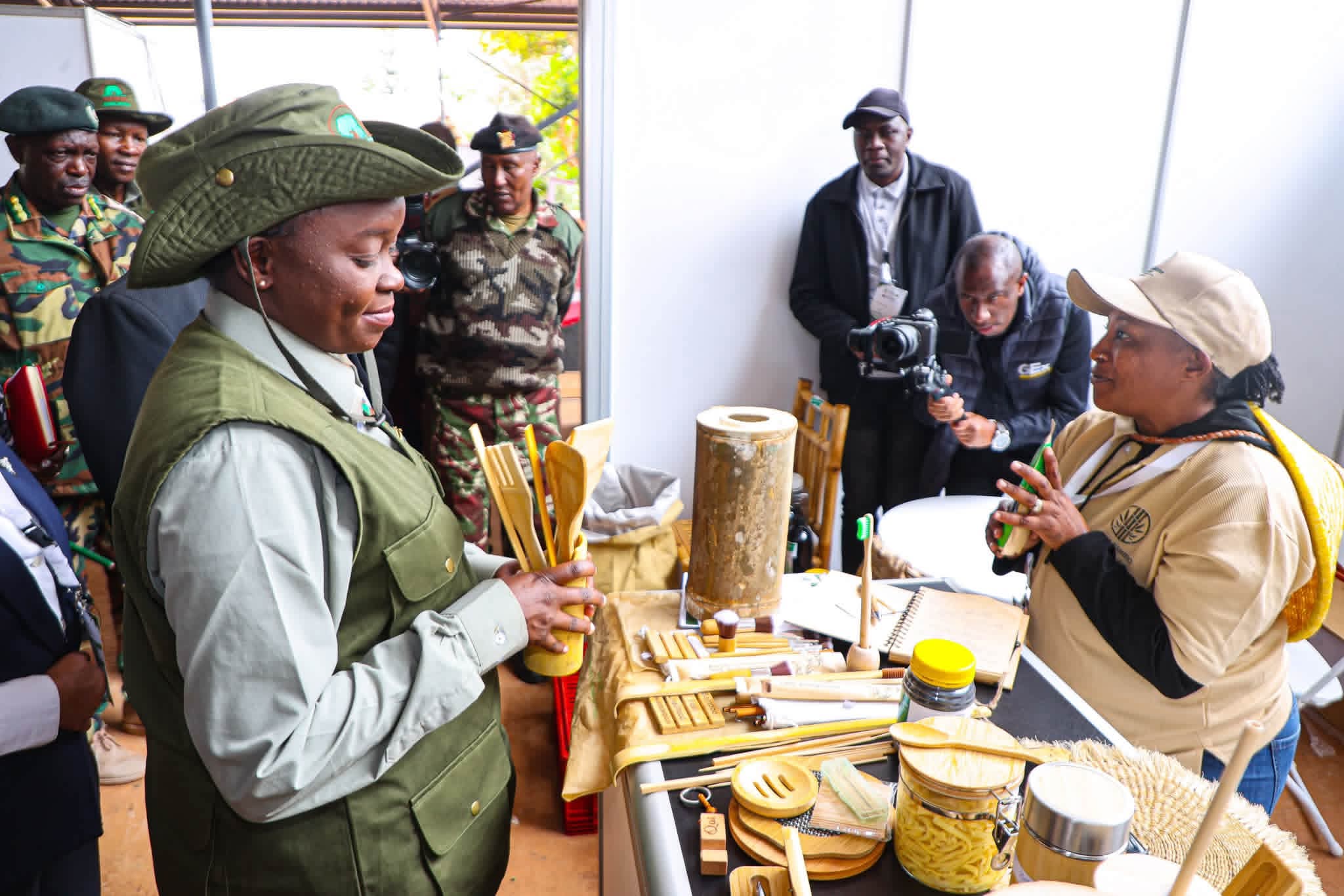
 Environment, Climate Change and Forestry Cabinet Secretary Deborah Barasa at the Meru University of Science and Technology during a bamboo expo on September 17, 2026. Photo by Dennis Dibondo


By Dennis Dibondo
Environment, Climate Change and Forestry Cabinet Secretary Deborah Barasa has urged Kenyans to invest in bamboo production and value addition, saying the crop presents a major opportunity to create jobs, protect the environment and boost the country’s economy.
Barasa said Kenya could learn from China, the world’s leading bamboo producer, by strengthening research, technology, marketing and value chains to take advantage of the growing global demand for bamboo products.
“There is a high demand for bamboo and especially its products in the USA, Japan and Europe, where they import products worth more than one billion US dollars. We can tap into this if we strategise as a country,” she said.
The CS said the Government had developed an enabling policy framework, including the National Bamboo Policy 2022 and the National Bamboo Development Strategy and Action Plan 2025–2035, aimed at promoting the production and utilisation of bamboo products locally and internationally.
She said the bamboo value chain had the potential to generate an estimated Sh17 billion for the Kenyan economy.
“Our task to our researchers is to know what to grow and centralise around farmers, improve bamboo nurseries and ensure we are propagating the right seedlings at the right time,” Barasa said.
The ministry, she added, plans to establish more than 10 bamboo nurseries across the country, with the capacity to produce over 10 million seedlings. The initiative will support the Government’s 15 billion tree-growing campaign and contribute towards the targeted additional 100,000 hectares of forest cover.
Barasa said Kenya currently has approximately 130,000 hectares of natural bamboo forests, predominantly comprising indigenous highland bamboo, in addition to bamboo cultivated on private land.
She said expanding bamboo production would create reliable markets for farmers, provide raw materials for industries, open opportunities for entrepreneurs and generate employment for young people.
Beyond its economic benefits, the CS said bamboo could play a critical role in restoring degraded landscapes, protecting water catchment areas and strengthening environmental resilience.
She urged Kenyans to move beyond simply conserving bamboo in its natural habitat and instead explore the wealth of opportunities presented by value addition and the wider bamboo value chain.
“Bamboo teaches us to remain rooted in our culture, science and economic growth. It also teaches us responsibility because it is home to biodiversity and is important for water security, food security and the carbon cycle,” she said.
Barasa spoke at the Meru University of Science and Technology during a bamboo expo, where she highlighted the crop’s potential to support resilience against floods and drought through regeneration and renewal.
The university’s Vice Chancellor, Professor Romanus Odhiambo, said bamboo could be used to manufacture a wide range of products, including fashionable clothing, fries and furniture.
He noted that China’s bamboo industry employs nearly eight million people, while Ghana had created more than 1,000 jobs through the sector, arguing that Kenya had the potential to achieve even greater success given its economic capacity.
Odhiambo said 18 African countries, including Kenya, had joined international bamboo organisations, and urged farmers to diversify their sources of income instead of relying solely on traditional cash crops such as tea, coffee and miraa.
Bamboo Association of Kenya Chairman Victor Mwanga said Kenya could significantly reduce its expenditure on timber imports by increasing bamboo production and promoting local processing.
Meru University of Science and Technology Board Chairman Professor James Kanya said he had been pursuing proposals aimed at encouraging the Government to introduce initiatives that would support the growth and development of the bamboo sector.