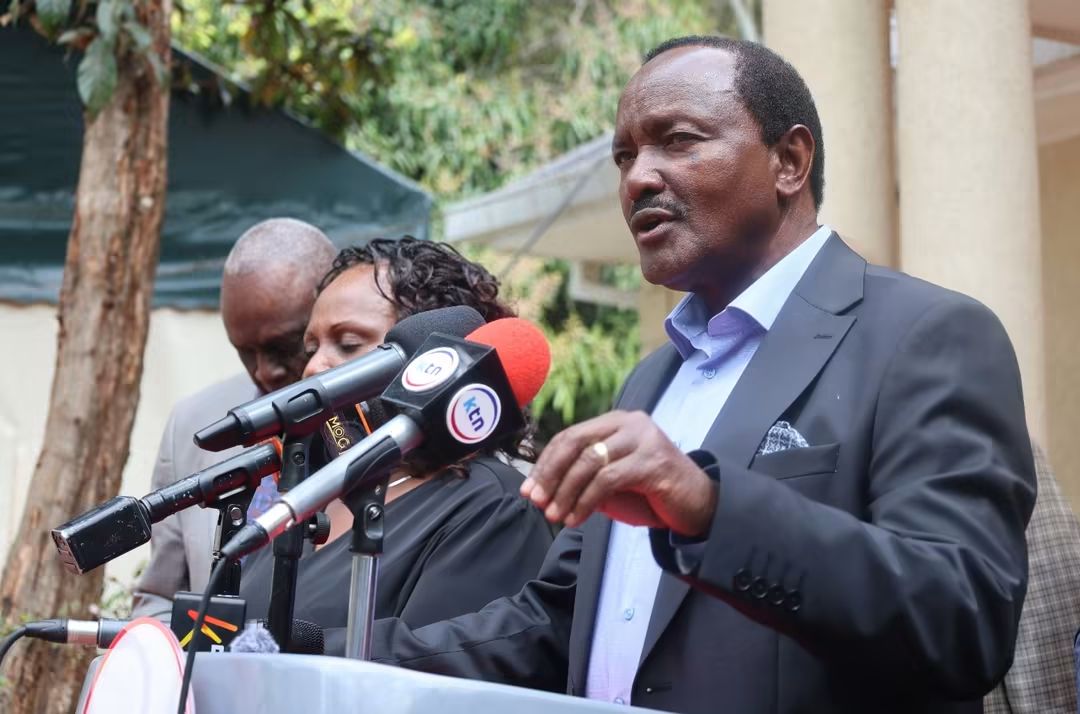
 Wiper Party leader Kalonzo Musyoka. File Photo


By Andrew Mbuva.
Wiper Party leader Kalonzo Musyoka has hailed the High Court’s decision to nullify the sale of a 15 per cent stake in Safaricom PLC, declaring that the shares must return to the people of Kenya.
In a statement issued on Wednesday, September 16, 2026, Kalonzo, who served as lead counsel in the constitutional petition challenging the transaction, said the judgment delivered by a three-judge bench on September 15 marked a significant victory for constitutionalism and public accountability.
“The people have won. Safaricom is coming home,” Kalonzo said, asserting that the court had declared the transaction unconstitutional, null and void.
According to the Wiper leader, the judgment quashed the sale, Sessional Paper No. 3 of 2025, parliamentary approval of the transaction and the related merger and acquisition arrangements. He said the court also ordered the restoration of the 15 per cent stake to the Government of Kenya on behalf of citizens.
Kalonzo argued that Safaricom was not an ordinary commercial enterprise but a strategic national asset supporting the country’s communications, financial systems and electoral processes.
He said the court had found several constitutional and legal shortcomings in the transaction, including what he described as inadequate public participation, the substitution of the approved buyer without disclosure, concealment of transaction documents and irregular procurement of advisers.
The opposition leader also challenged the government’s valuation of the shares, saying the transaction involved the sale of 6.01 billion shares at KSh34 each, amounting to KSh204.3 billion.
He added that the National Treasury received a further KSh40.2 billion as an advance against future dividends from the remaining 20 per cent stake, bringing the total amount involved to KSh244.5 billion.
Kalonzo said the government had not disclosed the valuation formula used to arrive at the sale price, arguing that the court found the process arbitrary and therefore incapable of producing a fair valuation.
He further linked the transaction to intergenerational equity, claiming that the government had effectively borrowed against future dividends that would otherwise benefit generations to come.
Kalonzo said the court also found that the transfer of majority control to a foreign entity had proceeded without a National Security Impact Assessment, contrary to constitutional requirements.
He maintained that M-Pesa’s role in Kenya’s financial ecosystem and the sensitive data handled by Safaricom made the company a strategic national institution requiring heightened safeguards.
He also claimed that the transaction had not been subjected to scrutiny under the Competition Act, arguing that it was presented as a financial transaction despite amounting in substance to a merger.
The Wiper leader accused the government of rushing to complete the sale after the Court of Appeal lifted conservatory orders on June 26, 2026.
He said the appellate court had not determined the substantive legality of the transaction but had only addressed an interim procedural matter.
“Twice, this Court issued conservatory orders halting this sale,” Kalonzo said, arguing that the government should have waited for the constitutional questions to be fully determined before proceeding.
He described the judgment as evidence of a broader pattern in which public assets were allegedly disposed of without adequate transparency, valuation or public participation.
Kalonzo warned potential buyers and other parties against attempting to trade, transfer or encumber the shares in defiance of the High Court ruling.
He said any such action would attract legal consequences, including possible contempt proceedings, insisting that parties dealing with public assets sold outside the Constitution risked inheriting legal disputes rather than secure ownership.
The Wiper leader concluded by urging Kenyans to remain vigilant and register as voters, arguing that while the courts had provided relief through the judgment, broader political accountability would ultimately be determined through elections.
The statement was issued in Nairobi on September 16, 2026.