
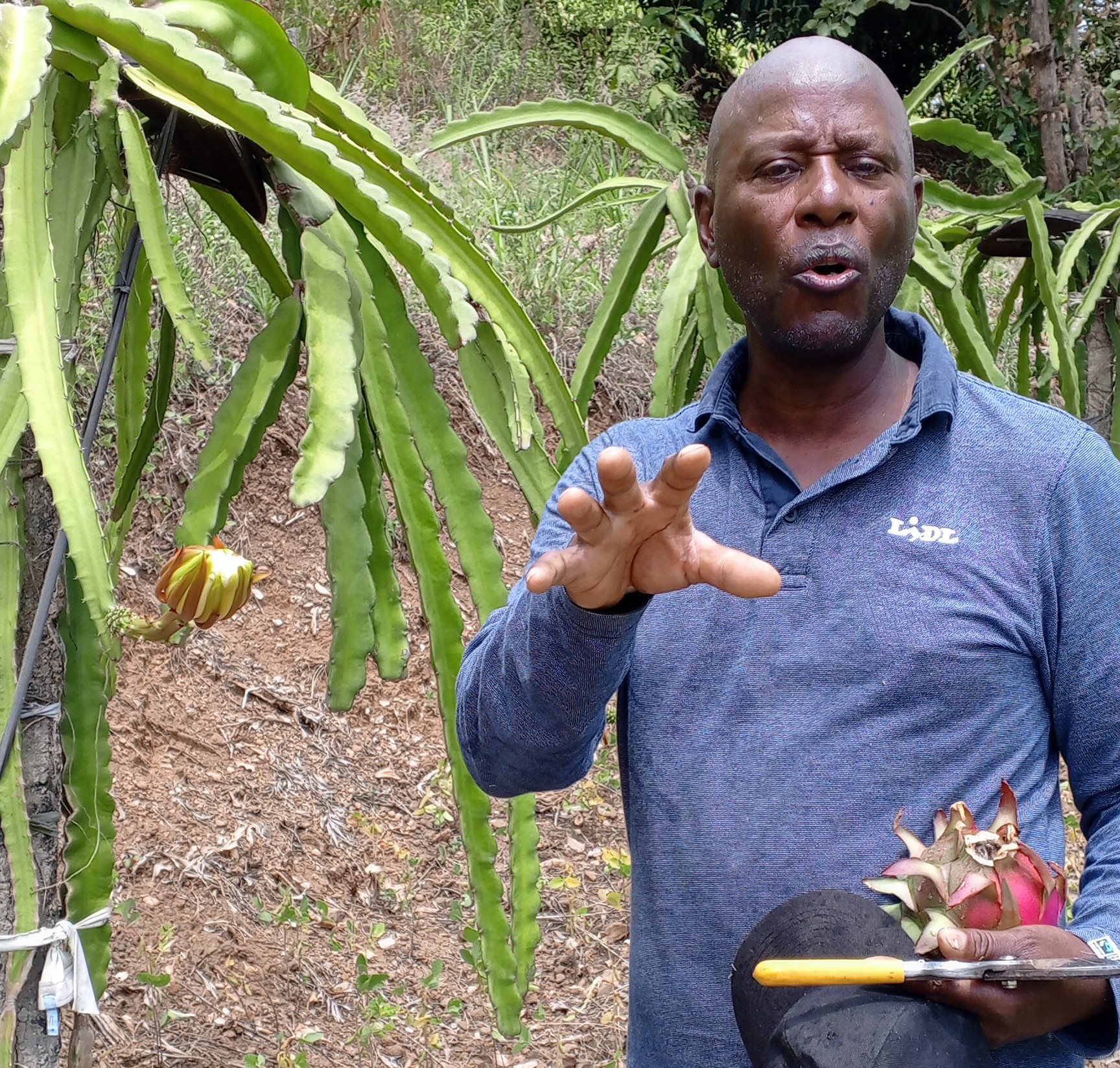
 Telecommunications engineer Antony Kinoti Mugambi at his dragon fruit farm in Embu. Photo by Dennis Dibondo.


By Dennis Dibondo
When telecommunications engineer Antony Kinoti Mugambi travelled to Guangzhou, China, on a work assignment in 2012, he never imagined that a mysterious fruit he tasted during the trip would eventually inspire him to establish one of Kenya’s pioneering dragon fruit farms.
The fruit left such a lasting impression that, for nearly a decade, Kinoti could not forget its unusual taste.
“Twenty-three years ago, I visited Guangzhou, China, and ate a very interesting food item. I didn’t know whether it was a plant, fruit, vegetable or processed item. It was melting in my mouth like ice cream,” he recalls.
Although he returned to Kenya and continued with his career in telecommunications, the memory of the strange fruit remained firmly etched in his mind.
It was during a subsequent visit to China that his curiosity was finally satisfied.
Kinoti observed that many Chinese people appeared healthy and energetic, regardless of their age. His Chinese friend, Alex Sundebao, told him that the secret lay in their approach to food.
“He told me that Chinese people eat food as medicine,” Kinoti says.
Sundebao introduced him to several foods, including Pak Choi, durian, mangosteen and dragon fruit. The name dragon fruit immediately caught his attention.
“The name Dragon Fruit made me curious because a dragon is a mythical creature. But he told me it was a very valuable fruit,” he says.
The two later visited a supermarket, where Sundebao picked what appeared to Kinoti to be an artificial-looking fruit, resembling a soft, vividly coloured pineapple. It was being sold for approximately US$10.
That was the moment Kinoti realised that dragon fruit was the same fruit he had tasted years earlier.
Determined to understand the fruit and possibly grow it in Kenya, he extracted seeds from the fruit and carried them home. He planted them and embarked on a long and uncertain experiment that would take years to bear results.
It was not until April 28, 2020, that he harvested his first dragon fruit.
The journey, however, had been far from easy. Kinoti says dragon fruit, scientifically known as pitaya, originated in South America and belongs to the cactus family. Unlike many conventional crops, it requires patience, technical knowledge and a willingness to experiment.
He discovered that wild cactus varieties could be crossed with dragon fruit to create new varieties. He eventually developed his own variety, a process that took four years to secure government patent protection for 25 years.
The protection, he explains, safeguards his intellectual property and prevents other entities from commercially benefiting from the variety without his consent or authorisation.
As one of Kenya’s early dragon fruit farmers, Kinoti had no local expert to turn to for guidance. Much of his knowledge came through trial, error and persistent research.
“One of the challenges is that some varieties are self-infertile. You have to wake up at night, collect pollen from another flower and pollinate them. The flower only opens for one night during its entire existence,” he explains.
He adds that growing dragon fruit from seed requires even greater patience, with plants taking between eight and 10 years to produce their first fruit. However, farmers using mature stems can significantly reduce the waiting period, with production possible within approximately 12 to 18 months under suitable conditions.
Kinoti is now encouraging farmers, particularly those in semi-arid regions, to diversify into alternative crops rather than relying exclusively on traditional cash crops.
He says warm climatic conditions are especially favourable for dragon fruit, allowing it to mature faster than in colder areas.
Following his first harvest, Kinoti expanded both his orchard and nursery. Despite the growing interest in the crop, he says he has yet to meet the market demand.
His work has also taken him beyond Kenya, where he has mentored more than 1,000 farmers across Africa. His first international visitor was Emmanuel Okine from Ghana, who travelled to learn from him in 2021 and has since established a successful dragon fruit orchard in Ghana.
The crop is gaining popularity because of its nutritional and health benefits, as well as its potential applications in the pharmaceutical and cosmetics industries.
In Kenya, dragon fruit can fetch approximately Sh1,500 per kilogramme, making it an attractive high-value crop for farmers willing to invest in its production.
Kinoti says the fruit is also believed to help reduce stomach acidity and hyperacidity.
“For instance, if you eat pepper and experience bitterness in your mouth, consuming dragon fruit can make the bitterness disappear within about two minutes,” he says.
Despite its commercial potential, dragon fruit farming comes with challenges, including pest attacks. Fruit flies are among the most serious threats, laying eggs inside the fruit, after which larvae develop and damage the produce.
To minimise reliance on chemical pesticides, Kinoti recommends the use of fruit fly traps fitted with pheromone-laced pesticides. The traps attract the flies into containers, where they are trapped and die.
From a mysterious fruit tasted during a foreign work trip to a thriving agricultural enterprise, Kinoti’s story demonstrates how curiosity, patience and innovation can transform an unexpected experience into a pioneering business opportunity.
His journey is also a reminder that Kenya’s agricultural future may lie in crops that remain unfamiliar to many farmers today—but could become tomorrow’s most valuable sources of income.