


By Andrew Mbuva.
Kenya’s learning crisis has come under renewed scrutiny after education stakeholders revealed that a significant number of learners are progressing through school without acquiring basic reading, writing and comprehension skills.
Speaking during International Literacy Day celebrations at Machakos Teachers College, education advocate Walter Odondi cited the latest learner assessment report by Usawa Agenda, which indicates that 35 per cent of every 100 Grade Six learners cannot read and comprehend a Grade Three-level English story.
Odondi said the situation becomes even more worrying when reading ability is considered alongside numeracy.
“Nearly one in two Grade Six learners cannot read a Grade Three-level story and solve Grade Three-level numerical problems. These are not just statistics; they are the facts on the ground,” he said.
He noted that behind every percentage is a Kenyan child who has spent years in school, progressed from one grade to another, yet continues to struggle with the basic ability to read and understand.
“Behind every percentage mentioned, there is a Kenyan child who has spent years in school and progressed from one grade to another, but may still struggle with the ability to read and understand,” Odondi said.
Odondi challenged education stakeholders to use International Literacy Day not merely as an occasion to celebrate reading, but as an opportunity to examine whether learners are actually acquiring foundational literacy skills.
He observed that Kenya has trained teachers, a curriculum and learning materials, but the continued challenges in foundational literacy raise questions about how effectively these resources are translating into learning outcomes.
“It is not only about celebrating reading. We must ask ourselves whether our children are actually learning to read,” he said.
Odondi warned that the country’s learning crisis begins at the foundational level, arguing that literacy must be treated with greater seriousness because it forms the basis upon which learners acquire knowledge in other subjects.
His concerns were echoed by Professor Francis Mathooko, Chairman of the Board at Machakos Teachers College, who said some learners can communicate fluently in English and even produce well-written work without necessarily understanding what they are reading or writing.
“Many students do not understand what they read. They can speak very good English and write good English, but sometimes they do not understand what they are writing,” Mathooko said.
Mathooko also raised concerns over the growing influence of digital learning tools and artificial intelligence, warning that the technology could undermine learning if misused.
He urged students to ensure that they understand information before using it in their academic work, rather than relying on technology to generate answers without developing their own comprehension skills.
Margaret Mwandale, Chairperson of the Academic Standards, Quality and Environment Committee at Machakos Teachers College, called for urgent interventions to address the mismatch between learners’ grade levels and their actual literacy abilities.
She said the worrying reports should prompt education stakeholders to strengthen literacy programmes so that learners are able to read, write and comprehend information appropriate to their level.
Eunice Bahati, a teacher trainee at Machakos Teachers College, described literacy as a fundamental pillar of learning, saying learners must master reading, writing and comprehension if they are to perform well across different subjects.
“Literacy is a key foundation in all subjects. Learners have to know how to read, write and comprehend so that they can perform well in other subjects,” Bahati said.
She added that strong literacy skills also enhance communication and social interaction, noting that the Competency-Based Education (CBE) approach builds learning progressively from what learners already know to new concepts.
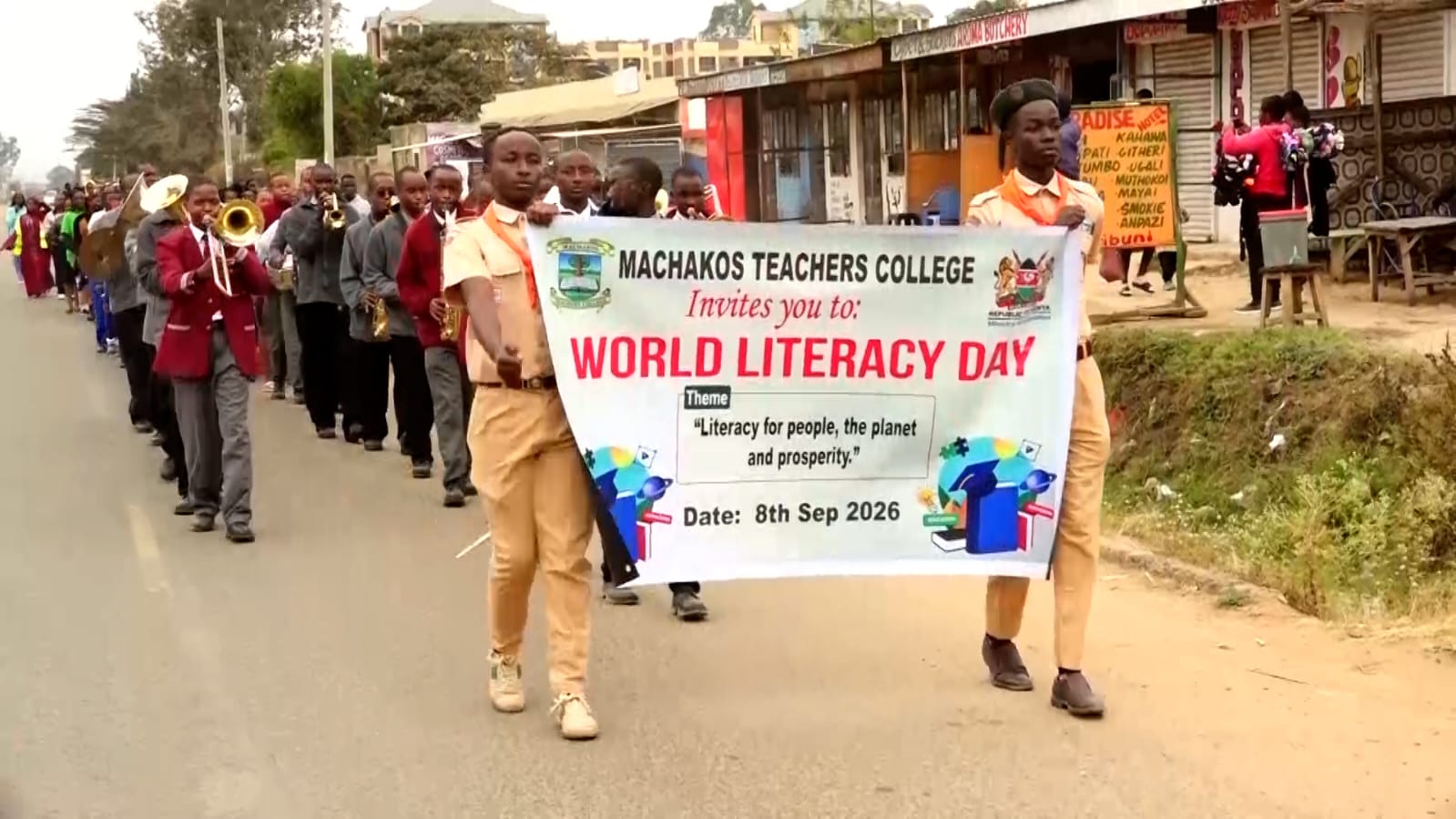
The International Literacy Day celebrations in Machakos brought together teacher trainees, educators and learners from several schools, including Machakos School for the Deaf, Machakos School for the Physically Disabled, Machakos Primary School and Manza Primary School.
The stakeholders called for renewed efforts to strengthen foundational literacy, warning that learners cannot effectively progress academically if they lack the basic ability to read, write and understand what they are taught.