
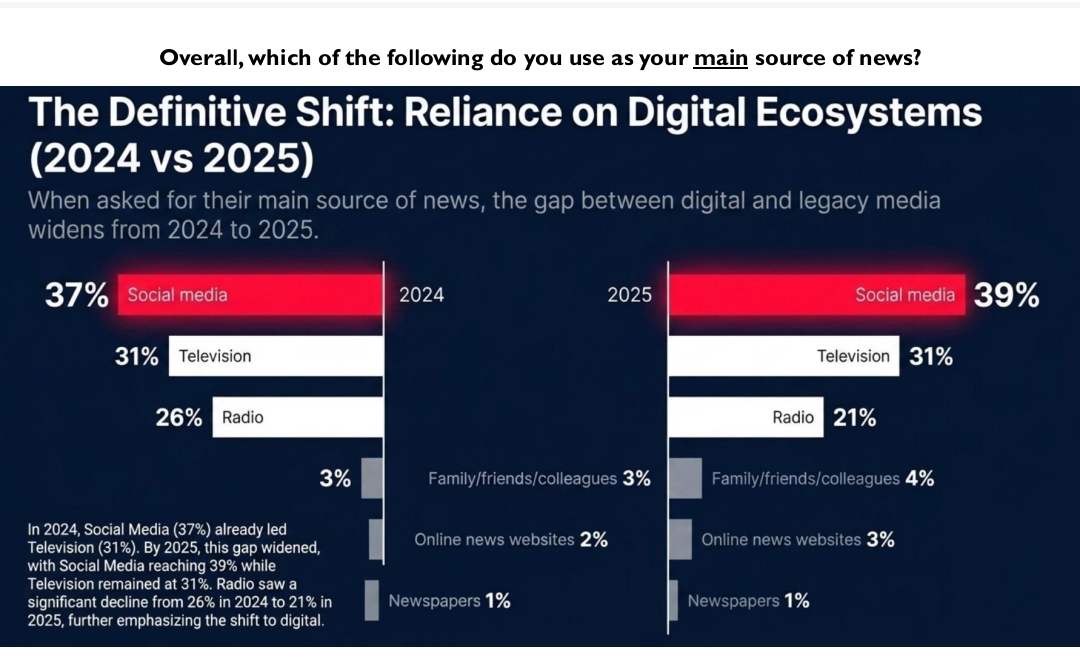



A new survey by the Media Council of Kenya has revealed a major shift in Kenya’s media landscape, with social media emerging as the country’s leading source of news as traditional platforms continue to lose ground.
The findings are contained in the State of Media 2025 Survey Report, which paints a picture of a rapidly evolving media ecosystem driven by digital consumption, changing audience behavior, and growing concerns over misinformation and artificial intelligence.
According to the report, 39 per cent of Kenyans now rely on social media as their primary source of news, overtaking both television and radio. The report describes digital platforms as “the leading new default” for news consumption in the country.
The nationwide survey, conducted between April 15 and April 23, 2026, sampled 3,774 respondents aged 15 years and above across all 47 counties. Researchers used Computer Assisted Personal Interviewing (CAPI) and reported a margin of error of ±1.7 per cent at a 95 per cent confidence level.
The findings indicate that television is steadily losing its influence among Kenyan audiences. Daily TV viewership dropped to 57 per cent, a decline of six percentage points from previous findings, with nearly half of the population no longer watching linear television regularly. Prime time remains the most preferred viewing period, with 73 per cent of viewers tuning in between 7:01pm and 10:00pm.
Print media has recorded the sharpest decline. Weekly newspaper readership has fallen from 29 per cent in 2022 to just 13 per cent in 2025, underlining the growing migration toward online and mobile-based news consumption.
Despite the declining fortunes of traditional media platforms, the report notes that public trust in the media has improved significantly. About 79 per cent of respondents said they had “some” or “a lot” of trust in the media, up from 74.5 per cent in previous surveys.
Perceptions regarding fairness in government coverage also improved. The number of Kenyans who believe the media covers the government unfairly dropped from 73.6 per cent to 46 per cent, signaling what the report describes as a “significant credibility gain” for the industry.
The survey further established that radio remains an important platform for many Kenyans, particularly outside urban areas, although digital media continues to expand its reach rapidly through smartphones and internet-enabled devices. Social media usage was found to be widespread, with many respondents spending several hours daily on digital platforms for news, entertainment, and communication.
However, the report raises alarm over increasing vulnerability to misinformation fueled by artificial intelligence-generated content. About 63 per cent of Kenyans surveyed said they are unable to identify AI-generated content, exposing many users to manipulation and false information online.
Additionally, 28 per cent of respondents cited misinformation and AI-generated content as one of their biggest concerns about the modern media environment, prompting calls for urgent digital literacy interventions.
The Media Council survey concludes that Kenya’s media ecosystem is undergoing a profound transformation, with digital platforms redefining how citizens consume information, engage with public discourse, and interact with the media industry.