
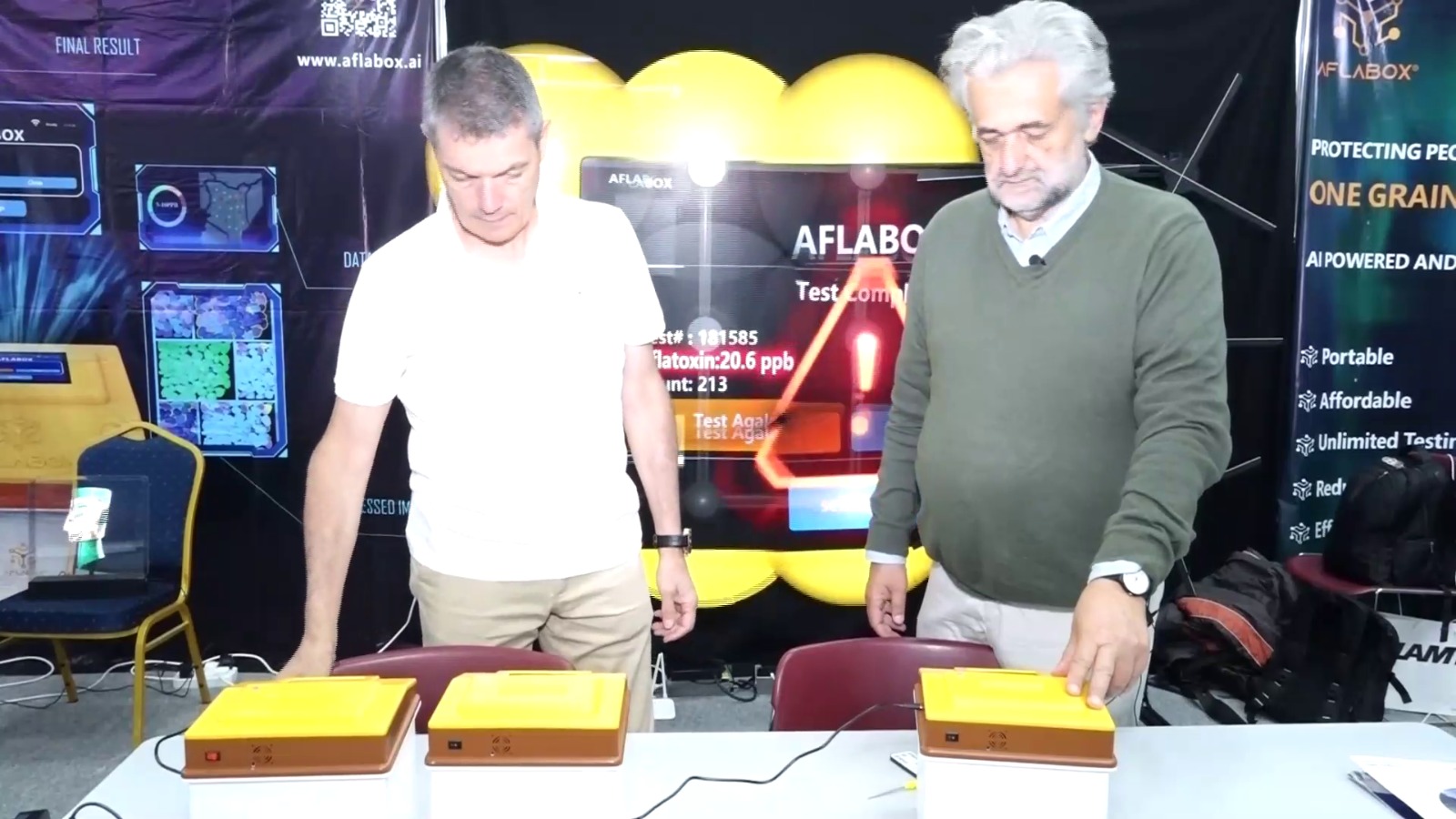
 The Chief Executive Officer (CEO) of Aflabox company Luca Alinovi and agronomist Alessio Collussi demonstrates the new innovation that detects aflatoxin at the farm level where they said that the aflatoxin kit which is portable and affordable to farmers uses Artificial Intelligence (AI) to detect aflatoxin levels in farm produce. Photo by Ben Okweingoti.


By Ben Okweingoti.
Farmers and millers across Kenya are set to benefit from a major technological breakthrough following the introduction of an innovative tool designed to curb aflatoxin contamination and reduce post-harvest losses.
The new device, known as Aflabox, uses Artificial Intelligence (AI) to detect aflatoxin levels in farm produce in real time, enabling farmers to take immediate action on contaminated crops. The technology is expected to significantly enhance food safety and strengthen food security by allowing early screening at the farm level.
Aflatoxin contamination remains a persistent food safety challenge in Kenya, particularly affecting staple crops such as maize, peanuts, and dairy products. The problem is especially prevalent in the Eastern region, where cases of contamination have been reported over the years.
Speaking during the Cereal Millers Association (CMA) Annual Technical Conference and Expo 2026 in Nairobi, CMA Chief Executive Officer Paloma Fernandes noted that both farmers and millers have long struggled with high levels of aflatoxin, particularly in maize, leading to substantial losses.
She cited past statistics showing the scale of the crisis, revealing that in 2012, about 65 percent of commercial flour on shelves was contaminated. Although efforts to address the issue have been made, Fernandes said that by 2020, contamination levels still stood at 50 percent.
“The aflatoxin levels have been consistently high, affecting not only maize but also milk and peanuts. This prompted CMA to begin self-regulation efforts, but the challenge has persisted over the years,” she said.
Fernandes further warned that some aflatoxin strains identified in 2020 were highly toxic and could pose immediate health risks to consumers, underscoring the urgency of adopting more effective detection and control measures.
She described the introduction of Aflabox as a game changer, highlighting its affordability and portability, which make it accessible to farmers, millers, and aggregators alike.
Developed by Italian firm Aflabox Srl, the device is designed to simplify aflatoxin testing by eliminating the need for complex laboratory procedures. According to the company’s CEO and co-founder, Luca Alinovi, the technology significantly reduces both the time and bureaucracy involved in testing.
“Instead of relying on biochemical processes, users simply place a sample into the device, and within 30 to 60 seconds, the results are available,” said Alinovi.
He added that the device operates through a Wi-Fi-enabled system, making it efficient and easy to use even in remote areas. In Kenya, Aflabox is represented by Aflazero, which is facilitating its rollout and adoption in the local market.
Alessio Collussi, an agronomist with Aflabox, emphasized that the device addresses a critical gap in aflatoxin detection. He noted that Kenya’s legal limit for aflatoxin in food is 10 parts per billion (ppb), yet testing has traditionally required sophisticated and often inaccessible laboratory equipment.
“Our goal was to create a simple, portable solution that allows farmers and traders to quickly identify contamination risks and take appropriate action,” Collussi said.
Agriculture Sector Network (ASN) Executive Board Member Dr. Wilson Songa welcomed the innovation, stating that it has the potential to transform aflatoxin management in Kenya and across Africa.
He, however, called on the government to establish supportive policies that will facilitate the adoption of such technologies and ensure proper handling of contaminated produce.
“We need a policy framework that supports the use of this technology and ensures that contaminated produce is safely transported to facilities capable of proper decontamination,” said Dr. Songa.
With its ability to deliver rapid, accurate results at the farm level, Aflabox is poised to play a critical role in safeguarding public health, reducing economic losses, and restoring confidence in Kenya’s food systems.